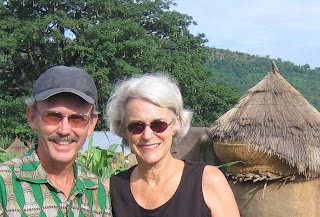
Wednesday, August 17, 2005

The next installment...

More from Africa, a place where occasionally we look at each other in astonishment and acknowledge that we are really here on this continent. It seems surreal at times. But then we slap that mosquito, wipe the sweat off our brow, take a cold shower and eat fu-fu for dinner, and we are reminded of where we are and where our home will be for the next two years. Someone asked us in an email (thanks, Pam) if we were happy, and the answer to that question is quite simply “yes!”.
It has been a while since we wrote last. We have returned from our week- long ”post visit” where we had a great time getting to know Atakpamé, our future home for the next two years. We spent time with the PCV (Peace Corps Volunteer) who has been there and was about to return home. She was well-loved and is leaving some big shoes to fill. She was well “integrated” into the community (a Peace Corps goal) and helped select both of our host national counterparts who will be helping us integrate. It was a busy week: We had dinner in four different Togolese homes, tasted the local millet beer, “chuch” which is served out of large plastic garbage cans and served in half of a dried out gourd (I wonder if that has anything to do with a small recurrence of the runs), attended a neighborhood football (soccer) match that was organized in honor of 2 departing PCV’s, and went to a meeting of the two HIV/AIDS NGOs (non-governmental agencies/non-profits) with whom we will be working! We even went to check out a Tai Kwon Do class at 6 a.m. one morning with the departing volunteer.
Best of all we attended a large luncheon in a nearby village that was set up by the director of the middle school there to say “Good-by to Kelly” (former PCV) and “Welcome to Cate & Wayne”. Kelly had helped get funding to build 3 new classrooms which reduced the size of their classes from 164 to “just” 87. The director of the school of 1000 students organized the luncheon at a large bar and 30 distinguished members of the village attended Not surprisingly for the culture, they were all men. Two chiefs were there (dressed in traditional cloth, one with his sceptre in hand and his cell phone in the other) as well as the regional education inspector (Superintendent) and 3 of his directors. We sat at the head table with the inspectors. Cate used her young French to charm the regional inspector. Once he seemed to know how little French we spoke, he felt free to use his limited English. So we had a nice conversation during lunch, which consisted of deep fried bread dough, hot sauce, spaghetti, bread and “interesting” beef pieces to eat with the traditional “sodabi” (a strong fermented palm wine), beer and chuch to drink. I sat between Cate and the only female education inspector in Togo. When it came to making speeches, Cate and I were asked, in good fun, to out-do the former PCVs with regard to building school buildings. Since THEY raised funds to build 3 classrooms, they want US to build six classrooms in two story buildings! There aren’t too many 2-story buildings. The former PCV gave a nice speech in good French (nearly made Cate cry even though she only understood half of it). It was reassuring to hear her communicate so well in such a setting, because she told us our French is better than hers was at the same time when she arrived in town. Cate jumped up when given the chance and charmed everyone with her very basic French telling them we were still learning French “un peu un peu” and saying “merci beaucoup pour votre bienvenu”. They laughed. Was it the pronunciation or the slow articulation? Whatever, we are slowly working our way into their hearts and it comes as a nice surprise that it is our limited French that is at work.
So enough details of our trip. I have noted a few cultural things to share and listed them below:
1. Always carry your baby on your back tied on with a colorful cloth. I have yet to see a baby crying in this position – but I have seen many napping. Sometimes you will see an “older” sister of 6 or 8 years carrying a 2 year old who looks almost half the size of the one doing the carrying.
2. Always pay for your purchase with your right hand. The left hand is reserved for bathroom tasks. It’s impolite to use it in greetings or business transactions and we have been warned it is quite bad etiquette to use it for eating.
3. Material success brings with it responsibility for the extended family. So think twice before you work hard towards success because you will probably be sharing it with your very-extended family. (C & T, can we come live with you in 2 years?)
4. Get well cards and flowers make no sense to Togolese. They expect fruit or money when you come to visit a sick person. Have to admit that their customs are much more practical!
5. Greetings are taken seriously. You greet everyone in the room when you arrive, normally with a handshake and appropriate salutation. Street greetings of “Bon Jour, Bon Soir or Bon Arrivée ” are common as well for anyone with whom you make eye contact.
6. All foreigners are greeted by any children who see them with “Yovo!” They will come running to greet you and sing the “yovo song”. Sometimes they want to touch you. It is difficult to be anonymous here, or just to go out and take a walk without kids “taunting” you with the song. We understand that the song is part of a rote greeting interchange that missionaries used to teach French. It drives some volunteers nuts as the singing draws constant attention but usually the kids are just having fun and want to acknowledge the unusual occasion of seeing a foreigner. They can pick out African-Americans as readily as us pale-faced yovos.
7. Wearing shorts is only for boys and old men. Working men wear pants.
8. Women normally cover their knees (and usually their calves) with dresses, or occasionally, pants. Revealing knees and legs is a sign of a loose woman.
9. It is impolite to cross your legs when meeting with a social superior.
10. If you are offered something to drink, even if it is not acceptable to you to drink (like unsafe water), put it to your mouth and let it touch your lips. Otherwise you will offend your host.
So now we are in our last 2 weeks of training and will soon be headed to our new home, assuming we pass all the requirements. All the volunteers are ready to go. Training has been very structured and at times frustrating and tiresome, and we are all anxious to get started on our own life and work in our respective villages and towns throughout Togo. Many of the returned volunteers we talked to on the phone before we started training said “just get through training”. Now we know what they meant. It will be sad, however, to leave the group of 23 volunteers that we have come to know quite well. We are making some good friends (who will never replace our true friends), and perhaps our next email will tell how they are helping to shape our lives here also. We think that we may come back to the US a lot smarter. (More on that in our next intelligent email).
Love to you all,
Wayne and Cate



Tuesday, July 26, 2005

To market, to market

Bonjour famille y amis,

(Two pictures at the bottom)

We write this from Atakpame, the town where we will be living starting in September. We have been sent for the week to start making living arrangements and getting to know the town. We are very pleased with the house where we will be living and the town itself, and have already met many people who have given us a warm welcome. It feels good. We are receiving a great deal of respect, due in large part to our age. It never felt so good to be so grey.

This week we have good internet connection, so we will send what I wrote a couple weeks ago about our first impressions of market day in our training village, Adeta. I write this in part so that those of you who will hopefully be visiting us will have an idea of what to expect. Visiting Africa may not be the exotic travel experience you were thinking. :)

Every village and town has one day a week that is designated as “market day,” the day where people come from all the outlying villages to sell their goods. It is different days in different villages. The larger towns, like the capital Lome, have it every day. Our first visit to the market in our village is hard to describe in any other way than as an “assault on the senses.”

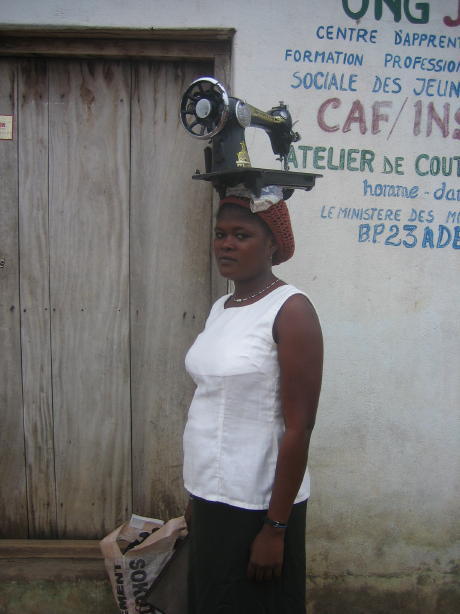
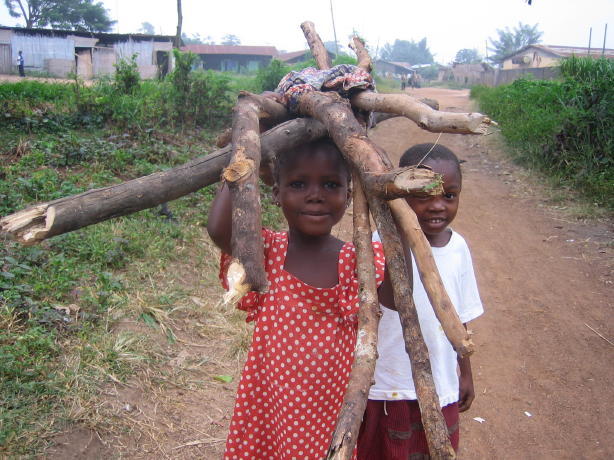
The market, in this village of 7,000, brings in hundreds of vendors and shoppers. It is a very busy scene with vendors coming in hordes with their goods crammed in trucks and tied on the top of vehicles. Many walk for miles with whatever they are selling in a big container carried on their head. (Nobody seems to carry anything any other way. The women often have a baby tied on their back, and a big aluminum basin filled with charcoal, bread loaves, yams, colorful fabric yards called pagnes, or dried fish, but their hand are free). They walk ever so gracefully, even the children, a! nd we have already gotten used to seeing everything carried this way. If a man is coming home from work in the fields, he balances his machete on top of his head. Children as young as 5 or 6 may carry a small pail of food. I saw a woman carrying a good sized dining room table. Everything goes on the head!

But I digress…Everything revolves around market day in the villages. Streets are nearly impossible to travel. Loaded cars and trucks, motos (small motorcycles also used as taxis to get around) have the right of way and come quickly out of nowhere. It is dangerous. I feel like walking around with my bicycle helmet on (well, not quite…). The smell of diesel surrounds the large market area as people load and unload their goods. We must walk through the congestion to get to the heart of the market. Pike Place at its busiest time of year doe! sn’t come close to this experience. Hundreds of venders, mostly women, are selling everything from small piles of dried fish set on a display table or the ground (the flies are very attracted to this), to pots of boiling sauces (sorry, we haven’t had the stomach to find out what they might be made of yet), to unwrapped bars of soap used for our hand laundry, and piles of “dead yovo” clothes. (“Yovo” is a foreigner, especially American. The dead yovo aisles are full of piles of used clothing, and they are referred to as “dead” yovo, because why else would yovos not want these perfectly good clothes unless they were no longer alive? The clothing is thrift shop genre, and I have already purchased a well worn white tank top for about 30 cents (which I used to learn how to batik from a local artist.)

Interspersed with these stalls of curious foods and not so appetizing smells, we find venders selling fabrics in beautiful colors and designs. They are sold in units called pagnes which are about 2 yards each. They come in various qualities, and therefore prices, and this is one of the first things we learned to bargain for in French. Pagnes are what all the women wear. The poorest wear them wrapped around their waist like a sarong. Wealthier folks pay tailors, who are a thriving business, (as are the hairdressers) who can make them into quite stylish, well-fitted outfits. Men buy the pagnes as well. Wayne is having 2 shirts made today for a $5.00 fee from the tailor ($2.50 each). We paid about $4 each for good quality fabric. Place your orders if you want us to send you a shirt. These pagnes are what makes life so colorful here, as even the poorest of the poor of all ages wear them in some form or another. They are worn until they no longer hold together, but still seem to maintain color. The clotheslines on wash days are pleasant to pass by.

There are also male vendors at the market, but not many. They are in the outlying stalls and have electronic equipment like radios which look like they might work, electric fans, batteries and various auto/moto parts.

It’s hard to describe the impact the market had on us the first time we experienced it. I felt horribly overwhelmed, truly, it was almost like being assaulted (OK, I’ve never been assaulted, but this is the only word which seems to fit). An assault on the senses. Aside from the sights and smells and crowds, the noise level is tremendous. Add to that the language/cultural barrier. The good news is that on subsequent visits we have become more accustomed to it, and now look forward to market day and have traveled to a larger neighboring town on their market day. We have actually bee! n able to bargain for pagnes in our newly acquired French: “C’est trop cher!! Diminuez le pris, s’il vous plait!”

Speaking of French, we know some of you are probably curious how we are doing. Although we wish it was coming faster, when we realize that we can form sentences (albeit limited in vocabulary) using 3 verb tenses, we realize we are indeed making progress. We’re working as a team on this….I seem to be speaking more, and Wayne seems to be understanding more. Some things don’t change. Anyone surprised?

So, I hope our little description of market day will encourage those of you who are on the edge of “to visit or not.”

Our hometown (“post” in Peace Corps lingo) in Togo, Atakpame, is quite scenic, nestled in the hills, and our home is (will be, starting September) well above West African standards and very comfortable. We have a fairly steep rocky hill to get to it, but the view is worth the effort and the calories burned will hopefully help negate all the carbohydrates we are eating. The food is quite palatable, although I have to add we are still being careful and haven’t totally gotten into what the natives are purchasing from the street vendors. But we are getting a little more adventurous every day as our digestive systems are acclimating.

We are loving your emails (for those of you who have not written, please feel guilty). Our trips to the internet cafes are highlights of our days. And now in Atakpame, we have found a route to the internet café that goes by the Fan Milk store – the best and only ice cream in town. We are lucky to have a store. In most towns, they are sold from coolers attached to bicycles and it is only by chance that you will see one when you want one. They are a little like the good humor man. So now we have ice cream (well it’s really frozen yogurt) AND your emails to look forward to as we walk! about town.

We are missing you all and feel abundantly blessed to have you as family and friends and know that you are thinking of us and praying for us . Sometimes Africa does not seem so far off, and 2 years not so long. Then again, sometimes it does! :) So, please, we want to know what’s going on in your lives, also, so that when we ret! urn we won’t feel like foreigners, the yovos that we are here in Africa. (And that’s a whole other email).


Love to you all---
Cate and Wayne


Thursday, July 21, 2005

Off to Atakpame

Bon jour

We are half way through our training now; 6 weeks in country and 5 weeks left in training. Tomorrow we meet our Togolese counterparts. They are the host country nationals that have volunteered to work with Peace Corps. They will be the folks we work with most closely in our jobs. Wayne’s counterpart works with computers in a computer maintenance/internet café business and Cate’s is an accountant for the Red Cross who is a board member with 2 nonprofits who have an HIV/AID grant to provide treatment to HIV patients. That’s as much as we know at this point but we will spend the day with them tomorrow so we will learn much more. On Saturday we will travel with our counterparts to the town where we will be for 2 years, Atakpame, and we will spend the week with them and the volunteer we will be replacing. We are looking forward to seeing our "post" and being in the house were we will live. It was the German capital of Togo prior to WW1 and still has some of the buildings which gives a German feel to the town. It is green and hilly so it sounds good. It is also larger than the town we are in for training, so we will have better email access with 5 internet cafes. So please write to us. As Dean Martin would say, "Keep "em coming. My Jeannie and me, we love to get those letters." Cate thinks I'm crazy for referring to Deano, so for the record this is Wayne writing. :)

Below are a few more photos whose titles are self explanatory. The one of Cate and me was taken at an African/American fashion show and we are wearing regal Kente cloth from Ghana that our host family loaned us. The group shot is the same day with the small business development half of the trainees and our trainers.


Sunday, July 03, 2005

Termites a flying

The other night we were sitting in our sitting room reading with the florescent light on. (Every room in the house has a light, but most are very low wattage florescent bulbs with just enough to light to see, but not read.) We started noticing a large insect or two flying near the light. Then there were 8 or 10 and then there were 30 or 40. This was within seconds! Our host mom, Philo, came in and started swatting them with a hand broom. We started looking around to find how they were getting in. When we checked the window screens we found them covered with bugs. We were in the midst of a flying ant or termite swarm. Apparently the rain that day was enough to force them out of the ground. They had wings about 2 inches long on 1 inch bodies. We determined that they were getting in under the front double doors, so Philo laid down a rag in front of the door but it did not cover the whole width. At that point it seemed we had hundreds of bugs inside so decided we needed to tu! rn off the light since that was what was attracting them. Then in order not to attract them into our bedroom we turned off that light too and started using flashlights. At that point there was not much else to do but go to bed safely protected under our mosquito net, so we got an early start on a nights rest. (We are really loving our mosquito net.) The next day all the volunteers were talking about the swarm which enveloped the whole village. Apparently some of the families were catching them and eating them raw after removing the wings. But some took the time to roast them, a real delicacy we presume.

Our mornings are much more pleasant than the evening just described. Due to the temperature being around 80 degrees most nights, we sleep with the windows wide open. The roosters start crowing around 4:30 AM, but in the 10 days we have been here we are already tuning them out so that they do not awaken us. Sometimes we hear singing from nearby or drums from far away starting around 5:30. Other morning sounds are a rhythmic sweeping outside and well water being drawn and poured from the well bucket into larger pans or buckets. (The house well is in the courtyard and has a cement wall around a 2 foot diameter hole. The water is about 30 feet down in the ground. There is a pipe in the well that provides the input to the pump that pumps water into to large tank connected to the house running water system. Don’t ask me why they still draw water with a bucket when the pump is right there. Perhaps they are saving wear and tear on the pump.) We are served breakfast around 6:30 AM! . Usually it’s hot porridge of rice, corn meal or tapioca - with bread and an egg – hard boiled, fried or omelet. Often there is a bucket of warm water in the shower for a bucket shower that was warmed over a charcoal stove outside. Running cold water showers are nicer later in the day when you’re hot. Our classes start at 7:30 and go ‘til noon. Then we have 2 ½ hours for lunch. At 2:30 we start class again until 5:30. Classes consist of French and Small Business Development sessions where we learn about Togolese culture and business. We also have health classes and safety & security classes along with bicycle repair classes.

On Sunday we went to a Baptist church with Philo. It is about a 20 minute walk from the house on the main road near the edge of town. Everyone dresses in their colorful finest for church. It is a simple, large structure like our house with cement walls but with lots of open pattern bricks for ventilation and a tin roof. It holds about 200 or 300 folks. It was very full. There are 6 foot long, 6 inch wide benches to sit on without backs. Men sit on the right side and women on the left. The service is done in both French and Ewe, the local African language. French is for folks who have moved here from elsewhere in Togo where Ewe is not spoken. "Blessed Assurance" was the first hymn sung by the congregation. Other songs were not as recognizable. They ask newcomers to stand and introduce themselves. Cate was moved to try it in French so she blurted out an introduction and told them were we in the Corps de la Paix. The broken French brought lots of smiles and laughter. A coed adult acapella choir of about 25 sang 3 songs with a definite African motif. That was the best part of the 1 ¾ hour long service for me. (They use an electronic organ, trombone and a one string base for musical instruments to accompany the congregation.) The preaching was pretty tame compared to some black Baptist preachers we have heard in the states. One of the texts was Romans 8, which will be recognized by the Lundring clan as Axel’s favorite scripture.

The other day we all went to meet the local tribal chief. He sat on a long porch with an assistant and we sat down on the porch as well. For starters we bowed down all together and said a local greeting in the local language. Then he welcomed us and we introduced ourselves in French. This meeting was done just for protocol to keep the local "powers that be" informed and respected. Chiefs are appointed by the ruling political party which has been in power since 1964 and just won the election in April.

On a more personal note we are feeling fine now, having recovered from our intestinal problems of the first week. (Other volunteers have had similar problems, but none hospitalized.) We are de-caffeinated, de-chocolatized and de-wined – something we thought would never happen! We have a cell phone working now so you can call us for 10 cents a minute. (It costs us over a dollar a minute so don’t expect a call from us.) Dustin and Claire have info on the cheap African calling card. Our number is:

001 228 903-3224.

The site Claire found is: http://www.zscomm.com/classic-africa.htm

We have talked to Claire, K&K and N&N so far. Call us any time between 6 and 9 PM our time (11AM and 2 PM Pacific Daylight Time).

Email access is very sketchy, but we have received many messages and thank you for your notes and encouragement. It’s hard to respond to each email, but it is GOOD to hear news from home, so please keep us updated on your lives, too. We are learning how to be patient with the internet…just one more cultural adaptation.

Love and blessings to each one of you!

Wayne and Cate

Now, some pictures (which you can also find here).


Thursday, June 23, 2005

What were we thinking?

Dear family and friends,

We have felt your presence and prayers. Thank you. Our first 10 days have not been easy and we have often referred to the prayer which sister Nada laminated for us: “Give us faith to go out with good courage, not knowing where we go, but only that your hand is leading us and your love supporting us.”

We already have many stories to tell, but I’ll start with the worst part. Wayne and I have both been sick – but have survived. Apparently amoeba are stronger than we are. I was the first ”to go” (with diarrhea) and spent 2 days in the PC/US Embassy Infirmary in Lome. The group was traveling the day I got sick to our training site 2 hours away, so I stayed behind alone. When I joined the group 2 days later, Wayne was also ill. The first night at diner he fainted as he got up from the table. Our host “mom”, Philo, is a nurse, & after some calls were made to the PC medical staff, we were off to the hospital where we spent the next 2 days. As it turns out he had a bad case of amoebas (causing extreme diarrhea) which caused dehydration, and for an added touch they also detected a small amount of malaria. (This is probably a false positive test – but is makes the story better J, However nobody here takes malaria lightly so they over detect when looking at the slide and give you some pills to cure the malaria. We are also taking a malaria prophylaxis, but it is only 95% effective.) He was on an IV for 36 hours and is doing well now, although still gaining energy. He left the hospital on Monday and started class on Tuesday. He has now fully recovered.

The hospital is run by Baptist missionaries and we had American doctors. He had a private room and I was given a mat to sleep on the floor in the same room. The equipment was quite primitive, but he received good care & attention. We were both glad to come “home”. The staff lives in a compound on the grounds which has a guest house where meals can be purchased. I went for meals there and took food back to Wayne since the hospital itself doesn’t serve food. The Togolese nurses, mostly all young men, were very nice & capable. The equipment (like the IV metal! stand) was totally rusted and the glass bottles looked well used, but we were not worried about sanitation as this hospital is known as the best in Togo. We both gave stool samples at some point. The container they gave Wayne was an old prescription pill container and mine was a Kodak film container. Seems like everything is recycled in this place.

Our host “Mom” is a lovely woman who is a nurse/midwife. Yesterday she delivered twins girls at the hospital, but in our compound/home she also has her own clinic and today there is a woman in labor. She has invited me to “help” sometime. We learned how highly respected Philo is at the hospital. The American doctors hold her in high regard as she has delivered over 2500 babies in the area in the last 20 years. She is from Ghana and speaks English, so although our French will not get as much practice, we are learning a lot. We lucked out on our home. We are only on! e of a few (maybe the only ones) to have running water. Most are getting their water from a well with a bucket. It looks very Biblical. We also have a flush toilet (no paper allowed) but most others have bucket latrines. If I were one of the young volunteers, I might be shouting “age discrimination.”

We are enjoying the group of other volunteers with whom we are training. One has already gone back home to Vermont. We are kept very busy in classes, learning French (W and I are in a class of 3), Small Business Development and “How to Stay Healthy in Togo”. We’ve had too many immunizations to report.

We have, we THINK, already survived the “What were we thinking?” stage of being here. They told us we would experience it, and we admit being here has seemed overwhelming at times, especially with health issues. It is not going to be easy, but there already have been great moments, and we expect they will multiply as we adapt to life here.

We have a nice clean room in an above standard home for Togo. The home has cement floors and walls and a wood ceiling under a metal roof. We sleep under a mosquito net (issued to us by PC along with our bikes, helmets, medical kit, kerosene lantern, water filter and propane stove…) on a comfortable bed and take refreshing (really!) cold showers or warm bucket baths. Food will be described in another email, as I feel we may already have lost half our readers.

We miss our family and friends but feel your presence and your prayers, and it is helping us to keep strong. So keep ‘em coming. Philo, our “host mom” is a Baptist and has enthusiastically asked to learn our table prayer. We have been blessed to be placed in her home.

Now it’s my turn – Wayne typing now. Not too much to add to what Cate said. The best thing about Togo is the people and their faces. The worst thing is the humidity. I expect in a few months we will get used to it. We said we were going to embrace change – well we have done that in spades. Peace Corps kind of doles out the change with a few days preparation in Philly, a few days in Lome” and now training – but it is still overwhelming when you experience it – especially with some hospital time thrown in feeling lousy. But now that I am mostly well I am still glad we have taken this adventure. So far it has not disappointed us in that regard.

Love to you all,
Cate and Wayne

Monday, June 13, 2005

Greetings from Togo

Monday June 13, 2005 6 PM local time (7 hours ahead time of the west coast.)

This may be more information than you want to read - but for those or you who are interested, here is how we are doing.

We have arrived from Philly without any problems and are in "Stage" training in Lome, as opposed to Pre-Stage training in Philadelphia. It rained pretty hard as we drove in from the airport, but stopped by the time we got to our "hotel". Actually we are staying in the American School residence where teachers stay and there are a few rooms to spare. The humidity is very high (92%) and the temperature in the upper 80s in the afternoon. Our mosquito net looks like 5 fine lace table clothes stitched together hanging from the ceiling by 4 corners. Our upstairs room is pretty nice with a private bath, but (as expected) without hot water. The windows are screened and of the horizontal slat type on opposing sides of the room. But without a fan to create much airflow, we are plenty warm. After getting settled in our rooms and an official greeting from the PC Director in Togo, we went to a nearby PC favorite bar "La Regent" for beers with the director and some PC staff. Other volunteers had come to town and were there to greet us and welcome us into the "PC family".

This morning we woke up to roosters crowing at a very early hour. This evening we are listening to sounds of a 3-on-3 soccer game being played by young men on a side street closed off for the game. The side streets, here by the coast in rainy season, are not paved but made of wet sand with some rocks thrown in for texture. First impressions include women walking balancing loads on their head (like a large platter of new flip-flops), looking down at he street and finding chicken tracks as well as footprints in the sand, and noticing quite a few large old satellite dishes on roof tops of the 2 and 3 story buildings. It seems to me that Lome is less developed than Guayaquil, Ecuador based on the number of paved streets and the small number of tall buildings. But the poverty level seems about the same. There are about 1 million people who live in the city and outskirts.

We got more shots and medical training today as well as a tour of the American medical facility for embassy personnel (of which there are 12 with 5 Marines to guard them) and Peace Corps (which numbers about 100 volunteers in total). We also got a language assessment test so they can group us according to our ability when we start language training on Thursday, 2 ½ hours north of Lome. Our test was short as we couldn’t say too much J. We continue to get to know the volunteers in our group better as well as the 4 experienced volunteers that are here to answer questions and help out during Stage training with cross cultural training. On Thursday we will be placed with a host family in Abade and the intensive French begins.

We walked about 8 blocks to the same bar again as last night. Played hearts and drank beer. Met some more PCVs from previous "stages".

Tuesday, June 14, 2005 11:15 am

Slept pretty well again last night. It was 83 F in our room when we went to bed and 79 F when we woke up. It’s not comfortable, but we sleep well anyway. More medical training today as well as more shots. Today covered how to use our water filter as well as how to use the stool sample preservation kit. This afternoon is cross cultural training from the experienced volunteers.

So we are doing fine and are using the internet café for the first time. Not sure what the access will be to internet cafes during training. We may have to resort to snail mail. More later

We are well and having fun.

Love to you all,

Wayne & Cate

We've arrived!

I'm sure they'll have plenty of stories about their travel and first days in Togo, but for now I'm (Dustin) just posting to pass on the message from the Peace Corps that they have safely arrived and will now begin training. Here's the email from Peace Corps:

--------------------------------------------------

Greetings.

This e-mail is to let you know that Peace Corps Togo Trainees: Wayne and Catherine Hillard arrived safely in Lomé, Togo last night (Sunday June 12th), and have begun their three month training to prepare for their service in Togo.

All Trainees will be staying in Lomé through Thursday morning (June 16th). On Thursday afternoon they will be traveling to their training sites in Adéta and Govié, which are located approximately 2 1/2 hours northwest of Lomé.

Cheers.

George Monagan
Country Director
Peace Corps/Togo

Robert K. Dedzi
Executive Assistant
Peace Corps
Togo

Tuesday, June 07, 2005

We begin the adventure

Where do we begin? The last month has been a wonderful whirlwind. Our house lease started on May 15th so we were slowly moving out for the month before that. Of course we had a flourish of activity at the end, cleaning until 3 am on May 15th. Then we were off to CA in a U-Haul truck loaded with a couple of couches & pulling the 4 Runner on a trailer for Claire & Tyler. The first stop was to visit Wayne’s dad Sacramento and spend a day at the cabin in Kyburz. Then we were on to Thousand Oaks for Claire & Tyler’s wedding on May 29th. They had things well planned and it was a great event that will be long remembered by all who were involved. We could not be more pleased with them and their celebration.
Then after a couple days of packing we were off to Claire & Tyler’s new apartment in Phoenix with another U-Haul. And then back to Seattle to Dustin & Julianna’s for a few days before going off to Philadelphia for 3 days of Peace Corps Staging. We depart from Philly to Paris on a June 11 red-eye and arrive in Lome late on the evening of June 12. We'll try to sneak into Paris on our six hour layover!


You can email us at: CateWayneAfrica @ yahoo.com

Don't expect an instant reply as we will probably only have access to email on the weekends during training.

The Happy Couple