Wednesday, June 14, 2006

Togo Scores!

World Cup Putting Togo on the Map

by James Helm BBC News June 7, 2006

When Togo played Saudi Arabia in a World Cup warm-up in Sittard, Holland, only a few hundred people turned up to watch. But what they lacked in numbers Togo's supporters, grouped behind a goal, made up for with their noise. The drums beat out a constant rhythm, flags were waved, and the songs exuberant.

A Togolese woman in traditional dress waved a national flag: "I feel so good about this day," she laughed. "You know, if you say you come from Togo, people don't know where Togo is. It is such a small country. Maybe now, with the World Cup, they will know about Togo.”

Wayne is writing this now an hour before the first ever appearance of Togo in the World Cup on June 13th. (For you non-sports fans, this is the tournament leading to the “Super Bowl” of world soccer that happens every 4 years.) I am sure many Americans are being exposed to Togo for the first time as a result of their being in the World Cup. They are probably wondering if Togo is somehow related to Togo’s sandwich shop. (The answer is no. I think Togo’s sandwich shop is named after the initials of a couple of San Jose State college students who started it back when my brother Dale was a student there.) But Togo is a long thin country sandwiched between Benin and Ghana and it is on a roll. (Thanks to John Crumpacker of the SF Chronicle for the puns.) Togo did well in the qualifying World Cup games last year, but then went to the African Cup tournament and lost every game. As a result, the Togo Soccer Federation fired the coach. In February they hired a new coach, but he quit on Saturday night. It seems the players were on strike because they had not agreed with the Togo Federation (run by the half-brother of Togo’s president) on the bonus money for playing in the world cup. (Apparently they did not get paid the promised amount for the Africa Cup, so they are playing hard ball.) On Saturday the coach said “How can I do my job if you can’t settle this? I quit.” That pretty much discouraged the Togolese people. Once again things go poorly for Togo. But this morning I saw on the internet that the coach has returned. Apparently the bonus dispute is settled. (Togo’s Prime Minister went to Germany to fix it). So perhaps the people are not as disappointed in the leaders as they were on Sunday. I was out this morning teaching the internet to a couple of our small business class students and the streets are full of folks wearing yellow, green and red, the Togo team colors. I can assure you the that Korea will come out on top in this match as Togo is now rated 61st in the world now and is playing in a tournament of the best 32 teams in the world, in which Korea came in 4th four years ago.

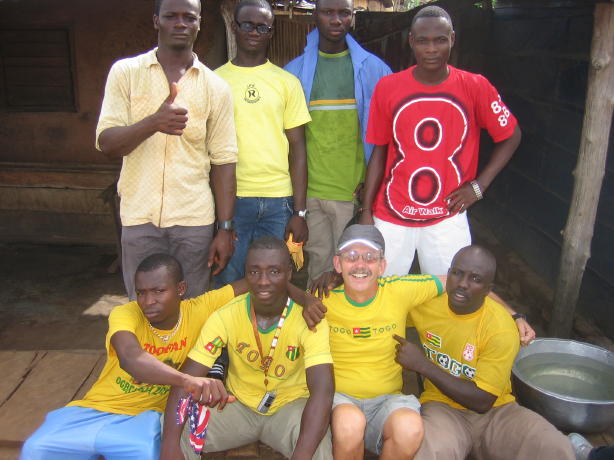
Now I have just returned from watching the game in the Atakpamé library with Cate. The stadium in Frankfurt was a sea of red, the Korean color. Very few Togolese fans were there as Germany denied visas to the 500 fans the Togo Federation tried to send to the games. (It seems that the fans did not submit their financial statements.) Atakpamé rolled up the streets during the game – the place looked deserted. The first half was great fun as Togo played well and was leading 1 - 0. The fans here went wild when we scored of course. See the photo. (I almost have to eat my words about losing.) But the second half went poorly and Togo lost 2-1.

So we walked home from the library with lots of disappointed folks in the streets. I was wearing my Togo T-shirt so I received lots of attention and encouragement; “Du Courage” they said in French, meaning “Have the courage to keep going”. The Togolese get a big charge out of seeing Westerners supporting them. I think they can’t quite believe it. (A few hundred years of colonization has only been gone since the sixties, so many Togolese still see white people as being here to run the place.)
The next game is against Switzerland on June 19th. Be sure to watch and root for Togo. J And our last game is against the unloved French on June 23rd. (We only keep playing if we come out in 1st or 2nd place amongst the 4 teams in our group.) Enjoy the game!

Wednesday, May 24, 2006

The Great Escape

It will soon be one year since we arrived in Togo, and we have just returned from a vacation to Morocco which has given us yet another perspective on life in Africa. Although Morocco is on the same continent, it felt like we left Africa since the culture and nearly all the people we saw there were Arab and/or Berber, both of whom came from the Middle East. Muslim is the predominant faith, and the dress is long robes for both men and women, with many covered female faces. Most Westerners visiting Morocco think it is quite poor, but from our West African perspective, it seemed quite developed. Gourmet meals, hot running water, reliable and comfortable travel, and fun shopping made us feel like we were living “high on the hog.”

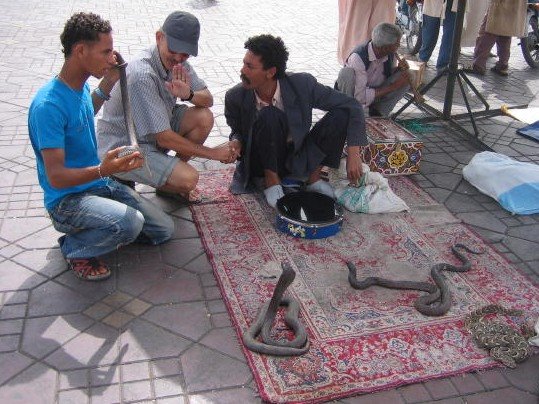
As part of our Moroccan adventure, we stayed in “riads” - lovingly restored, beautiful and somewhat quirky centuries-old homes (narrow stairways, tiny doors, tranquil courtyards) inside the walls of the old cities. The cities themselves were amazing places to visit with lots of juxtaposition of new and old: Donkeys carry baskets on their backs for garbage pick-up while passing high tech internet cafes situated in a labyrinth of stone paved pathways not wide enough for cars. Women walk the family bread dough daily to the neighborhood baker to be baked in a wood-fired oven (just as has been done for centuries) while men talk on cell phones in front of their own shops. A motorbike pulls up to a butcher shop counter on the street (where un-refrigerated beef hangs on the hook) and the driver purchases the day’s meat, departing without dismounting. Wandering around the Djemaa el-Fna square amidst the snake charmers and acrobats, what rolls by but two tourists on Segway transporters, new fangled machines that look like overgrown lawnmowers we have only seen on TV newsreels & read about until now.

We spent our first day in the very cosmopolitan Casablanca visiting the 3rd largest mosque in the world and the only one open for touring to non-believers in Morocco. King Mohammed V built it in the 90’s in 6 years with local workers working around the clock, an impressive place on the ocean, holding 25,000 worshippers (with a retractable roof and huge titanium doors) costing over half a billion dollars. It was decorated by Moroccan artisans with geometric tile and wood carvings. (Muslims are not allowed to depict living things in their art). We enjoyed lunch at “Rick’s Café” where Wayne, in a Humphrey Bogart state-of-mind, sat at the piano and Cate asked him to “play it again, Sam.”

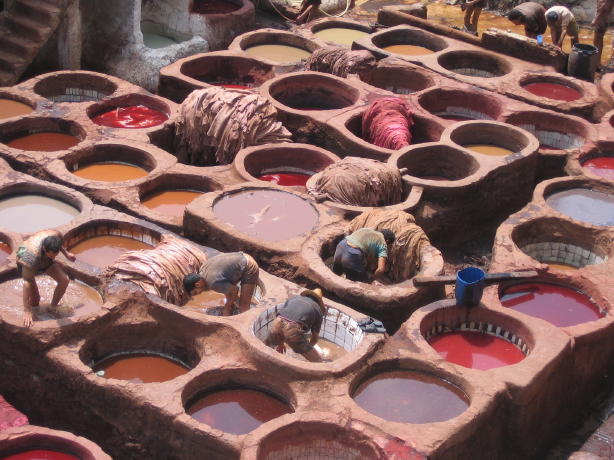
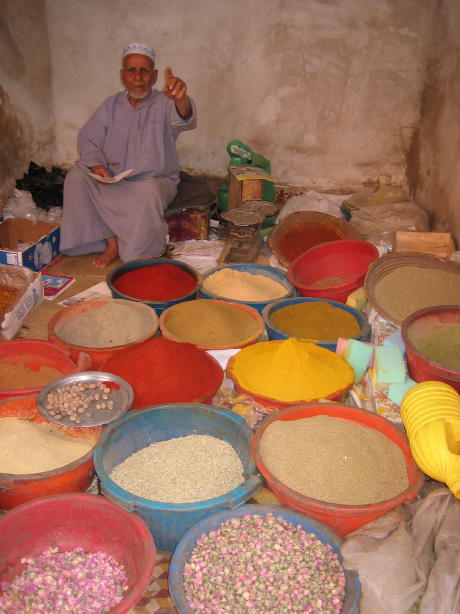
Fes, the “symbolic heart of Morocco” was the most cultured, artistic, religious and refined town we visited. It is 3 towns in one; ancient (as in medieval), old (13th century) and new (French colonial). We focused on the ancient walled city called the medina and needed a guide to show us around the incredible maze of over 9000 tiny, twisting alleys, narrow streets and blind turns. And what trip to Morocco would be complete without a rug purchase (so Cate said), so we succumbed and felt like we had the Moroccan equivalent of a timeshare condo sales pitch, leaving it feeling both remorseful and happy; remorseful about the price but happy with our choice. (The thorough sales pitch by our now best Moroccan friend who served us traditional mint tea during the presentation, included the fact we could resell the rug on eBay when we got back to the states and it would pay for our trip. That’s why we took his suggestion and ended up with more than one rug and are feeling a little sheepish…maybe from all the lamb we ate?). We also visited a large pottery shop to see pots, dishes and tiles being hand made and painted by boys and men. Then on to the tanneries where the foot stomping process of dying leather in small vats of vegetable dyes remains unchanged over the centuries. We also saw hand weaving of silk and cotton into beautiful cloth. The colors, crafts and goods of Morocco were a feast for our eyes, especially in relation to Togo where the economy is so bad creative arts suffer and mostly essential items are found in the shops.

The next day we visited Volubilis, a Roman ruins site dating from the 2nd and 3rd centuries and one of the most remote Roman outposts. The high point was the stunning mosaic floors left in their original locations, now exposed to the elements, that were walked on 1900 years ago. Then we visited the small neighboring town of Mouley Idress where a leader of the same name founded the country’s first dynasty in the 8th century after he was driven out of Mecca by rival Muslims, bringing Islam to Morocco. It is a picturesque, white walled city situated on a hill surrounded by lush vegetation.

We then traveled south through the Atlas mountains in a taxi where stops included a visit with free-roaming monkeys in the wild, a very animated poor village rug market and an elitist ski resort village. After a night in a small, dusty, dry mountain town we downgraded to local bus service to get to Essaouira, an ancient beach town known for its 18th century ramparts and movie making by Orson Wells. Our guest house was inside the old town looking down on the rocky Atlantic coastline just outside the walls. Fortunately Essaouira is much smaller than Fes and we were able to find our own way around the medina. Now it is mostly a fishing port and tourist destination for Europeans. We had a great lunch on the dock with our own hand selected fish grilled in front of us. As Americans we were quite unique. We tried to use our French (Morocco being a French-speaking country), but they would almost always gleefully answer us in halted English. I guess our accent is a dead give-away. We especially enjoyed the Mediterranean climate. It was the first time since our arrival in Togo that we have used our Seattle fleece jackets. We knew we brought them for a reason!

Our last city was Marrakesh where another old restored city mansion gave us much needed respite from the hustle and bustle of the city. Marrakesh, founded in 1062, has a walled medina (old town) which includes a large plaza pretty much dedicated to the tourist, both Western and Moroccan. Restaurants surround the big plaza in which they promote the medieval myth and mystery of Marrakesh with snake charmers, story tellers, acrobats, musicians, jugglers and henna artists. The aroma of grilled meats and fresh squeezed oranges permeate the area and located nearby is the myriad of “souqs” (small markets) which sell every handicraft made in Morocco and include tiny meat markets, hardware stores and motorbike repair shops.

We went to Morocco with high expectations and happily we were not disappointed. Returning “home” to Togo, however, was surprisingly nice, especially the feeling of it being “home.” Our community of friends missed us and gave us a warm welcome back (did they think we might not return?). We appreciate even more now the evident joy of life here, shown in the way people talk, laugh, dress and move to whatever rhythm they might be hearing. We realize we have developed a comfort level with some of the quirkier facts of life here. Our mid-Eastern experience in Morocco gave us a stronger appreciation for the essence of Africa and we’re glad we’re here in Togo. For family and friends, however, don’t worry about us extending our time (as some volunteers do). We are also looking forward to the perspective we will have upon returning to the US.

Wednesday, April 19, 2006

Have you seen Him?


Have you seen Him? Easter morning we started looking at 4:00 a.m. along with hundreds of other Christians in Atakpamé who started celebrating early.

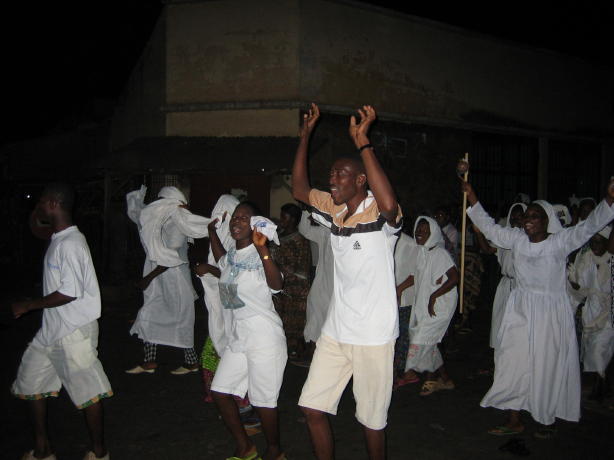
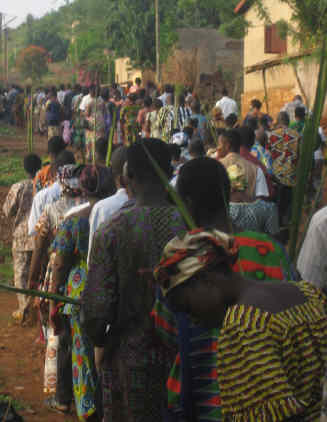
Easter day starts early for Christians in Togo. Up at 3:30 a.m., dressed in white from head to toe as we were instructed (like the angels at the empty tomb), we paraded through the streets of town with a loud brass band and drums “searching for Jesus”. During 2 hours of walking and dancing, perhaps 8 kilometers, we covered most of the town, including the cemetery, and celebrated that He was nowhere to be found. All this was to symbolize “He is risen indeed!” Alleluia! You will see from the photo that it was a joyful bunch.

Holy Week is by far the most important religious week of the year for Togolese Christians and the central activity of the week consists of processions through the community. Palm Sunday is marked by a parade with palm leaves that leads to the church. We went to the neighborhood Catholic service at 6 a.m. where the congregation met in the street just around the corner from our house for a brief service and then paraded to the church, about 1 kilometer away, with palm leaves in hand singing acapella. (See photo) This is one of 3 Catholic churches in town and the sanctuary was packed with 500+ folks for worship. Maundy Thursday worship is centered around foot washing, but we didn’t learn about that until afterwards, so we will wait until next year for that experience.

On Good Friday we again joined the local Catholic congregation. Worship started outdoors across town from the church, beginning at high noon, a time not insignificant in this heat. We processed with hundreds of Togolese, stopping to kneel in the street at 14 different Stations of the Cross situated around town, leading towards the church. (See photo) After 2+ hours of processing, praying and kneeling, the service at the church (so we understand) lasted another 3 hours. Needless to say the Togolese relate to the suffering of Christ.

We celebrated Easter morning with 3 other Peace Corps volunteers who joined us at our home for breakfast after the “search” and before the 9:00 a.m. worship service. It, too, was a very joyful service. There was lots of singing and dancing in the aisles as they collected the offerings by having the entire congregation circulate up to the alter to place their offering in the plate – twice – to brass band music and singing and dancing. The women were all dressed to the hilt in their new pagnes (the colorful fabric here) and elaborate hairdos.

We were fortunate to be invited into the home of a Togolese family for a traditional Easter meal of salad and pate (a starchy corn meal paste similar to a dumpling) with two different kinds of sauces. See photo — Wayne looks happy, eh? We think the experience of visiting a home and sharing a meal is worth a separate email in the future.

We are really enjoying learning and experiencing first hand the African traditions, but we also miss the traditions we have in our personal history, centered around our church, family and friends at this time of year. We colored hard boiled eggs (to the delight of our Togolese friends), taught some children how to do an Easter egg hunt, shared our treasured M & M’s…but it’s just not quite the same. We miss our family and friends! Hope you all had a wonderful Easter celebration.


Wednesday, March 29, 2006

Total Experience Eclipse

God’s blessings shined on us today as there was not a cloud in the sky this morning. The partial eclipse began around 8 am and was only viewable with the special dark glasses which turned the sun into a dark orange orb on a black background that was gradually eaten away. It progressively got cooler in the sun and a little darker until right on time at 9:15 am the total eclipse started and we could look at the sun without our special glasses and see the corona. (I wonder how much brain and computer power it took to calculate the exact time of the eclipse for every point in the path from Brazil to Mongolia?) We could see one star but it was still light enough to walk around. It was like dusk – not midnight. Then after 3 minutes it was as if someone flipped on a light switch as about 1% of the sun peeked out from behind the moon and you needed your special glasses again to look at the sun. The whole process made our planet’s place in the solar system very tangible.

The Togolese national government declared a half day holiday today and everything was closed up tight this morning. The roads normally teeming with people were empty. No school and no work. Everyone was at home with their family behind closed doors as the media had educated folks to use the special glasses or stay inside and not look at the sun. Everyone we talked to yesterday to was too afraid to trust the glasses and they were staying inside. About half an hour after the total eclipse the neighborhood boys showed up to use our glasses. It was a very quiet morning near our house except for the roosters and guinea hens crowing again after the eclipse. For us, it was most likely a special once in a lifetime experience.

Sunday, March 19, 2006

March 29, 9:15 a.m. END OF THE WORLD

Wednesday, March 29, at 9:15 a.m., Togo will experience what some say is one of the most awe inspiring spectacles in all of nature: A TOTAL SOLAR ECLIPSE. Atakpamé, our home town, is just about exactly in line for some of the best viewing of this event in the world. Good timing for us to be here!

In simple scientific terms a solar eclipse can be explained as: “An eclipse of the Sun can only occur at New Moon when the Moon passes between Earth and Sun. If the Moon’s shadow happens to fall upon Earth’s surface at that time, we see some portion of the Sun’s disk covered or “eclipsed” by the Moon.

More esthetically speaking, this total solar eclipse (which will only last a few minutes) can be described as: ”The sky takes on an eerie twilight as the Sun’s bright face is replaced by the black disk of the Moon. Surrounding the Moon is a beautiful gossamer halo. This is the Sun’s spectacular solar corona, a super heated plasma two million degrees in temperature. The corona can only be seen during the few brief minutes of totality. To witness such an event is a singularly memorable experience which cannot be conveyed adequately through words or photographs.” (That’s why we’re writing before the event…)

But to those Africans not “in the know,” the temporary morning darkness may cause panic. We’ve been told some people will think it is the end of the world, that what is happening is a war between the sun and the moon, and if either one should lose, obviously it’s not good. To combat the “war,” there will be noise-making: drumming and banging of basins throughout the town, pleading for the orbs to stop fighting. Schools will be closed for the day to minimize fears.

Lucky for us, Peace Corps Togo has supplied all the volunteers with special eclipse shades for viewing the eclipse without causing any permanent eye damage. Radio and TV broadcasts have started publicizing the event with cautions about eye damage. Locals have started talking about it rather excitedly, and pharmacies are now selling eclipse shades for about 60 cents, a big expense for an item used only once, and about the cost of one day of food for many people here.

How will we celebrate this event? We are planning a small party, serving a light brunch afterwards with the obvious menu choice: Eggs Sunny-Side Up.

If you feel like you are missing out on this grand event, you can look forward to the next two total solar eclipses visible from the US which will occur on August 21, 2017 and April 8, 2024.

If you are interested in finding out more, check out NASA’s technical web site:

http://sunearth.gsfc.nasa.gov/eclipse/SEmono/TSE2006/TSE2006.html

or for the layperson:

http://solar-eclipse-2006.info/index.html

Saturday, March 18, 2006

Thin Mints $30/box

This message is for all the Girl Scouts out there, and for any of you who think their cookies are too pricey:

Support your Girl Scouts and BUY those cookies. And think of what it would be like if they weren’t available at all. Girl Scout Cookies are not sold here in Togo, and Peace Corps Volunteers really miss them. They miss them so much they are willing to buy a box for $30.00, and on volunteer “salaries,” that is a big chunk of change. But that calls for further explanation…

Last week, Togo volunteers gathered together for an annual conference. The schedule included an auction one night with items donated by volunteers and staff.

The auction helped raise funds for girls’ educational scholarships, part of the Girls Education and Empowerment Program. Girl Scout Cookies were one of the hottest items, although Oreos and M & Ms were very close seconds. A dinner date in the capital with a hunky U.S. Embassy Marine guard went pretty high, too. There was also a silent auction with sought after items like US brands of deodorant and other cosmetics (some partially used), good batteries like EverReady (we think they were unused), DVDs and CDs (maybe in good condition), volunteer art J, etc.). All in all, the auction will help provide over 30 girls with one year of education in secondary school. Not bad, especially considering it came from volunteers’ pockets!

Don’t pass up the opportunity to buy from those cute scouts and please, munch one for us! (We were not lucky enough to win a bid for the cookies, but we’ll make up for it when we return to the US)

p.s. Good luck with your sales, Marlene!

Monday, February 27, 2006

Dancing on Stilts

Local Atakpamé folklore has it that long ago a hunter went into the bush to hunt, only to find one-arm, one-legged magical creatures jumping and dancing on stilts. He threw some burning embers into the air to draw their attention, but they fled in fear without their stilts. He brought the stilts to the voodoo spiritual leader to have him explain their mysterious powers. After that experience, he made some similar stilts and tried them himself. From that beginning, stilts have become part of the local culture. They are traditionally used now for various joyous occasions, like the end of the harvest.

Picture five local village troupes of stilt dancers competing for the most outlandish, crowd-pleasing choreography set to traditional music in a stadium full of 3000 people. Visualize acrobatic feats on 12 foot stilts. Imagine a 4 year old shinning up a stilt to be pulled up on the shoulders of a stilt dancer. Conjure up “otherworldly” costumes and frightening masks that keep the dancers safe from evil spells. Create in your mind a flowing gold, gigantic, gilded creature with very long arms and legs. Now you have a picture of the Stilt Dancing Festival.

Friday was a great day for a Peace Corps cross-cultural experience in Atakpamé. KAGBEMA, an organization that we work with, held their 2nd annual Stilt Festival here (called Tchébé in the local language of Ife). Stilt dancing is unique to the Atakpamé area in Togo. The cultural tradition is being revived by this festival. A French stilt artist was here to make it an international affair with his graceful, gold creature. (It turns out shepherds traditionally used stilts in France to keep track of their sheep, but he is a contemporary very artistic stilt dancer.) To top it off, the new US ambassador to Togo and his wife to take in the culture and visit with Peace Corps volunteers after the event.

Hope you enjoy the photos and can view the short videos.

Wayne & Cate


Tuesday, February 14, 2006

What are we doing here, anyway?

WHAT ARE WE DOING HERE, ANYWAY?

This is a question we often ask ourselves. And because many of you have asked about our work (maybe it sounds like we are having too much fun?) here is an attempt to explain what we’re doing (besides reading, studying French, drawing, traveling, sweating, sleeping, watching DVDs, and socializing).

Peace Corps goals are three-fold:

  1. To help the peoples of interested countries in meeting their needs for trained men and women.
  2. To help promote a better understanding of the American people on the part of the peoples served.
  3. To help promote a better understanding of other peoples on the part of the American people.

These first 8 months, we feel like we’ve made good headway on goals # 2 and 3. Indeed, we think we’ve integrated into our community quite well. The Togolese are getting to know us (in Atakpamé, we are known as “the couple” – pronounced “la coop-la” in French--and we are greeted everywhere we go). You, our reader, have also helped us (goal #3) by reading our emails, being interested in our life and work here, and we think probably raising awareness in your own circle of friends…the ripple effect. Thank-you. We are amazed how many “hits” our blog (for folks not on our email list) is getting, and when we tried to pare down our mass email list, it only grew. So thanks to you we’re not feeling so isolated in Togo. And that works for us.

Goal #1 is the hardest goal to determine just how successful we are/can be. Our work thus far is really intangible. Our French is now at a survival -- but working -- level. (We continue our tutoring 8 hours a week if we don’t have too many other meetings). However it’s one thing to struggle to make conversation in a new language and its another to stand in front of a group and teach. But at this point we just ask them to indulge our poor French and dive in. We have listened to many proposals from locals who would like to work with us, and we have sifted through the proposals to make decisions on who to work with: what projects are verifiable and/or sustainable; who is “serious” (as in goal-oriented, honest and focused); is the organization transparent, i.e. can we track the money to see that it is being used for what it was intended. Would we like working with the person?

Many, and maybe most, volunteers still feel a lack of direction at this point in their service. Although we had an idea when we came what we might be doing, the reality is quite different. For example, the internet cafés Wayne thought he would be helping are already pretty well developed in our community, yet the NGOs Cate is working with are sorely in need of technical support. Thus, we have ended up working together in the same organizations, offering our own strengths: Wayne, computer wizard and Cate with organizational skills. We attend a lot of meetings that have the common denominator of not starting on time.

Integration into the community is considered part of our work, so just hanging out with the locals, getting to know them and gaining their confidence is “work.” Sometimes that means sitting down and having a beer with them. Pretty hard to feel accomplishments in that respect…but our PC literature tells us that a chief source of frustration may be the sense that our efforts seem to yield few tangible accomplishments. The impact of what we do may not be felt for years, so they tell us to maintain a sense of perspective with our goals, accomplishments and relationships. Our personal focus is to develop people, not things; empower people to create new opportunities and take charge of their own future. Sometimes we feel jealous of the volunteers who have well (as in water) projects for their village, as they seem so badly needed and a well is such a tangible thing. But our role in small business in a medium size town does not fit with village well projects.

All of that being said, listed below is a range of issues, organizations and activities that we are either already working on or looking into:

  1. HIV/AIDS. We inherited a project from our predecessor volunteer and have been meeting with 2 NGOs (non-profit organizations) since our arrival. Our role consists of controlling the international project funds and advising the two NGOs, one medical and one psycho-social. Between the two, they give free HIV tests, psycho-social counseling, medical treatment, group support, home visits, nutritional support, community sensitivity and AIDS orphans outreach. We offer organizational aid, computer knowledge, approval of bank withdrawals, reporting of funding requirements, moral support, and sometimes act as facilitators at stormy meetings with the 2 organizations who really don’t like each other much but are required to work together due to funding sources. With their help we have plans to do some presentations to high school classes on AIDS awareness and prevention. Emphasis is on 1.) Condoms (we’ll do a demonstration on how to use them with a wooden penis that PC provides), 2.) Abstinence and 3.) Fidelity. Sexual talk is open and frank and not embarrassing to the Togolese.
  2. SMALL BUSINESS SKILLS. We have recently started teaching a class in business skills to small business owners such as tailors, hair dressers (the 2 predominant small businesses in Togo), and other small business entrepreneurs. We’re popular! The first class doubled in size after the organizational meeting. We make up our own curriculum & first taught “What is Cash Flow and How to Track It.” Next class: “Selling and Buying on Credit” (not credit cards…they are nonexistent here…but small informal loans which are made often without keeping records). Interesting cultural differences complicate these simple concepts.
  3. CULTURE PRESERVATION AND APPRECIATION.
    • Participation in organized traditional dance and drum demonstrations. Good for locals to see we are interested. Americans have rhythm, too. Well, sort of.
    • Theater Festival organization. World AIDS Day community street skits on AIDS awareness and prevention. (street skits create a good awareness level in Africa)
    • Organizing committee (Treasurers) for 2nd annual Stilt Dancing Festival – an almost lost art once famous in Togo. Email and photos to follow after Feb. 24.
    • Sharing of culture: purchasing local jewelry and art, wearing of beautiful local fabrics (support your local tailor). Cate is having fun with this one, and the locals seem to really enjoy seeing their culture being valued and enjoyed by our culture. (How’s that for justification for buying stuff?)
  4. OPENING AND MARKETING OF NEW ENGLISH LANGUAGE INSTITUTE. We are helping with the grand opening (which means interviewing and hiring a teacher, finding adult students, marketing the classes) of an Adult English Language Institute. Our predecessor PCV helped get the building funded.
  5. CHILD TRAFFICKING. Unfortunately, this is a real problem in Togo. “For the price of a bike”…a child is sold into slavery. We have been asked to help in this arena and are just beginning to get involved with help in finding funding support for a local NGO (non-profit).
  6. COMPUTER TRAINING in business software for non-profit organizations. Wayne has just started teaching a class on Saturday mornings to the staff of a local non-profit.

We will be writing more on these subjects if you are interested, and as our work progresses and we learn more. Thanks for helping us feel a tangible result when you respond to our emails. Hint, hint.

So, not quite in a nutshell, that’s what we’re doing here.