Wednesday, May 24, 2006

The Great Escape

It will soon be one year since we arrived in Togo, and we have just returned from a vacation to Morocco which has given us yet another perspective on life in Africa. Although Morocco is on the same continent, it felt like we left Africa since the culture and nearly all the people we saw there were Arab and/or Berber, both of whom came from the Middle East. Muslim is the predominant faith, and the dress is long robes for both men and women, with many covered female faces. Most Westerners visiting Morocco think it is quite poor, but from our West African perspective, it seemed quite developed. Gourmet meals, hot running water, reliable and comfortable travel, and fun shopping made us feel like we were living “high on the hog.”

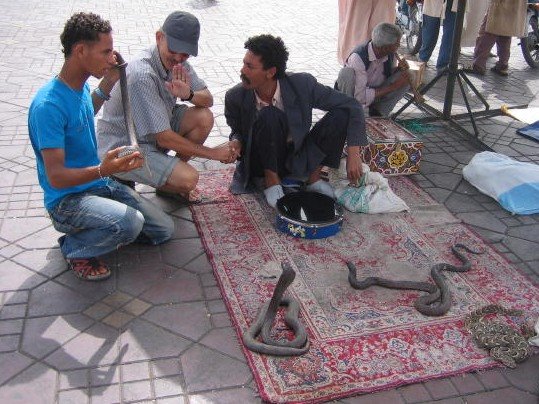
As part of our Moroccan adventure, we stayed in “riads” - lovingly restored, beautiful and somewhat quirky centuries-old homes (narrow stairways, tiny doors, tranquil courtyards) inside the walls of the old cities. The cities themselves were amazing places to visit with lots of juxtaposition of new and old: Donkeys carry baskets on their backs for garbage pick-up while passing high tech internet cafes situated in a labyrinth of stone paved pathways not wide enough for cars. Women walk the family bread dough daily to the neighborhood baker to be baked in a wood-fired oven (just as has been done for centuries) while men talk on cell phones in front of their own shops. A motorbike pulls up to a butcher shop counter on the street (where un-refrigerated beef hangs on the hook) and the driver purchases the day’s meat, departing without dismounting. Wandering around the Djemaa el-Fna square amidst the snake charmers and acrobats, what rolls by but two tourists on Segway transporters, new fangled machines that look like overgrown lawnmowers we have only seen on TV newsreels & read about until now.

We spent our first day in the very cosmopolitan Casablanca visiting the 3rd largest mosque in the world and the only one open for touring to non-believers in Morocco. King Mohammed V built it in the 90’s in 6 years with local workers working around the clock, an impressive place on the ocean, holding 25,000 worshippers (with a retractable roof and huge titanium doors) costing over half a billion dollars. It was decorated by Moroccan artisans with geometric tile and wood carvings. (Muslims are not allowed to depict living things in their art). We enjoyed lunch at “Rick’s Café” where Wayne, in a Humphrey Bogart state-of-mind, sat at the piano and Cate asked him to “play it again, Sam.”

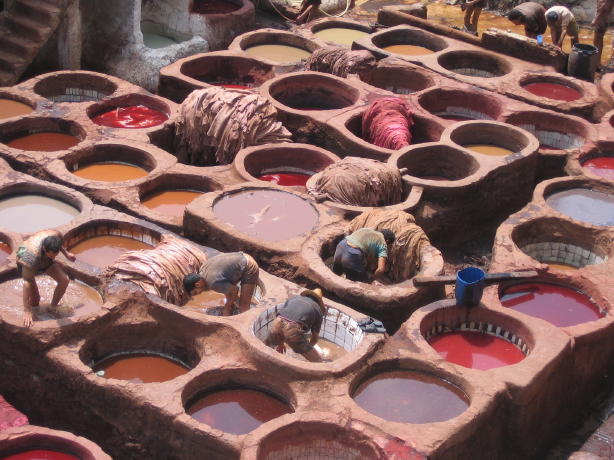
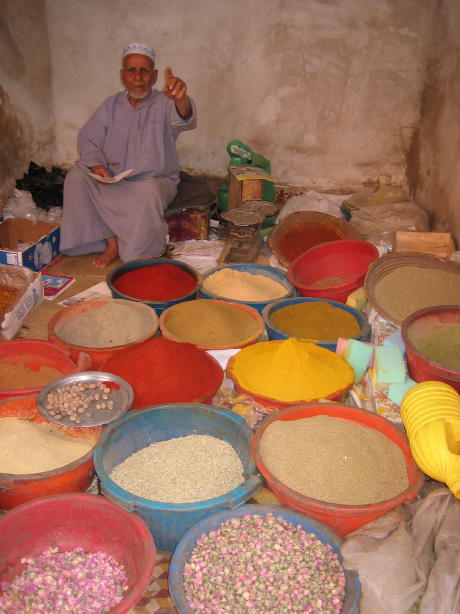
Fes, the “symbolic heart of Morocco” was the most cultured, artistic, religious and refined town we visited. It is 3 towns in one; ancient (as in medieval), old (13th century) and new (French colonial). We focused on the ancient walled city called the medina and needed a guide to show us around the incredible maze of over 9000 tiny, twisting alleys, narrow streets and blind turns. And what trip to Morocco would be complete without a rug purchase (so Cate said), so we succumbed and felt like we had the Moroccan equivalent of a timeshare condo sales pitch, leaving it feeling both remorseful and happy; remorseful about the price but happy with our choice. (The thorough sales pitch by our now best Moroccan friend who served us traditional mint tea during the presentation, included the fact we could resell the rug on eBay when we got back to the states and it would pay for our trip. That’s why we took his suggestion and ended up with more than one rug and are feeling a little sheepish…maybe from all the lamb we ate?). We also visited a large pottery shop to see pots, dishes and tiles being hand made and painted by boys and men. Then on to the tanneries where the foot stomping process of dying leather in small vats of vegetable dyes remains unchanged over the centuries. We also saw hand weaving of silk and cotton into beautiful cloth. The colors, crafts and goods of Morocco were a feast for our eyes, especially in relation to Togo where the economy is so bad creative arts suffer and mostly essential items are found in the shops.

The next day we visited Volubilis, a Roman ruins site dating from the 2nd and 3rd centuries and one of the most remote Roman outposts. The high point was the stunning mosaic floors left in their original locations, now exposed to the elements, that were walked on 1900 years ago. Then we visited the small neighboring town of Mouley Idress where a leader of the same name founded the country’s first dynasty in the 8th century after he was driven out of Mecca by rival Muslims, bringing Islam to Morocco. It is a picturesque, white walled city situated on a hill surrounded by lush vegetation.

We then traveled south through the Atlas mountains in a taxi where stops included a visit with free-roaming monkeys in the wild, a very animated poor village rug market and an elitist ski resort village. After a night in a small, dusty, dry mountain town we downgraded to local bus service to get to Essaouira, an ancient beach town known for its 18th century ramparts and movie making by Orson Wells. Our guest house was inside the old town looking down on the rocky Atlantic coastline just outside the walls. Fortunately Essaouira is much smaller than Fes and we were able to find our own way around the medina. Now it is mostly a fishing port and tourist destination for Europeans. We had a great lunch on the dock with our own hand selected fish grilled in front of us. As Americans we were quite unique. We tried to use our French (Morocco being a French-speaking country), but they would almost always gleefully answer us in halted English. I guess our accent is a dead give-away. We especially enjoyed the Mediterranean climate. It was the first time since our arrival in Togo that we have used our Seattle fleece jackets. We knew we brought them for a reason!

Our last city was Marrakesh where another old restored city mansion gave us much needed respite from the hustle and bustle of the city. Marrakesh, founded in 1062, has a walled medina (old town) which includes a large plaza pretty much dedicated to the tourist, both Western and Moroccan. Restaurants surround the big plaza in which they promote the medieval myth and mystery of Marrakesh with snake charmers, story tellers, acrobats, musicians, jugglers and henna artists. The aroma of grilled meats and fresh squeezed oranges permeate the area and located nearby is the myriad of “souqs” (small markets) which sell every handicraft made in Morocco and include tiny meat markets, hardware stores and motorbike repair shops.

We went to Morocco with high expectations and happily we were not disappointed. Returning “home” to Togo, however, was surprisingly nice, especially the feeling of it being “home.” Our community of friends missed us and gave us a warm welcome back (did they think we might not return?). We appreciate even more now the evident joy of life here, shown in the way people talk, laugh, dress and move to whatever rhythm they might be hearing. We realize we have developed a comfort level with some of the quirkier facts of life here. Our mid-Eastern experience in Morocco gave us a stronger appreciation for the essence of Africa and we’re glad we’re here in Togo. For family and friends, however, don’t worry about us extending our time (as some volunteers do). We are also looking forward to the perspective we will have upon returning to the US.

Wednesday, April 19, 2006

Have you seen Him?


Have you seen Him? Easter morning we started looking at 4:00 a.m. along with hundreds of other Christians in Atakpamé who started celebrating early.

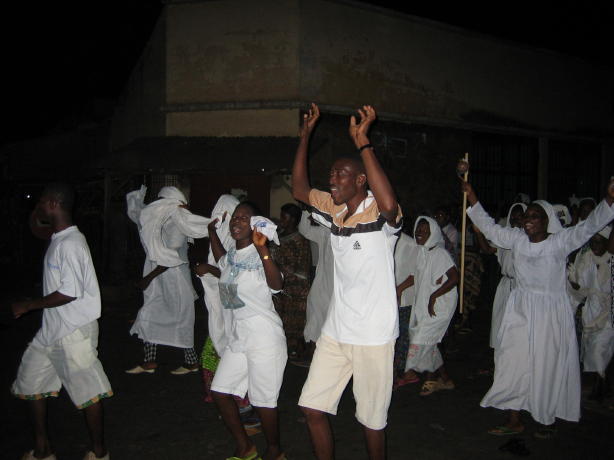
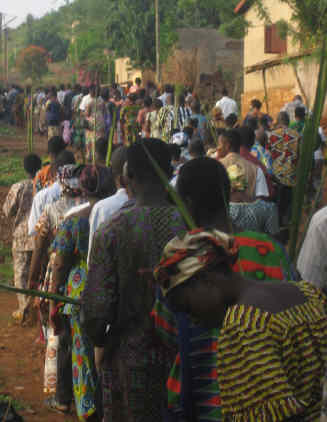
Easter day starts early for Christians in Togo. Up at 3:30 a.m., dressed in white from head to toe as we were instructed (like the angels at the empty tomb), we paraded through the streets of town with a loud brass band and drums “searching for Jesus”. During 2 hours of walking and dancing, perhaps 8 kilometers, we covered most of the town, including the cemetery, and celebrated that He was nowhere to be found. All this was to symbolize “He is risen indeed!” Alleluia! You will see from the photo that it was a joyful bunch.

Holy Week is by far the most important religious week of the year for Togolese Christians and the central activity of the week consists of processions through the community. Palm Sunday is marked by a parade with palm leaves that leads to the church. We went to the neighborhood Catholic service at 6 a.m. where the congregation met in the street just around the corner from our house for a brief service and then paraded to the church, about 1 kilometer away, with palm leaves in hand singing acapella. (See photo) This is one of 3 Catholic churches in town and the sanctuary was packed with 500+ folks for worship. Maundy Thursday worship is centered around foot washing, but we didn’t learn about that until afterwards, so we will wait until next year for that experience.

On Good Friday we again joined the local Catholic congregation. Worship started outdoors across town from the church, beginning at high noon, a time not insignificant in this heat. We processed with hundreds of Togolese, stopping to kneel in the street at 14 different Stations of the Cross situated around town, leading towards the church. (See photo) After 2+ hours of processing, praying and kneeling, the service at the church (so we understand) lasted another 3 hours. Needless to say the Togolese relate to the suffering of Christ.

We celebrated Easter morning with 3 other Peace Corps volunteers who joined us at our home for breakfast after the “search” and before the 9:00 a.m. worship service. It, too, was a very joyful service. There was lots of singing and dancing in the aisles as they collected the offerings by having the entire congregation circulate up to the alter to place their offering in the plate – twice – to brass band music and singing and dancing. The women were all dressed to the hilt in their new pagnes (the colorful fabric here) and elaborate hairdos.

We were fortunate to be invited into the home of a Togolese family for a traditional Easter meal of salad and pate (a starchy corn meal paste similar to a dumpling) with two different kinds of sauces. See photo — Wayne looks happy, eh? We think the experience of visiting a home and sharing a meal is worth a separate email in the future.

We are really enjoying learning and experiencing first hand the African traditions, but we also miss the traditions we have in our personal history, centered around our church, family and friends at this time of year. We colored hard boiled eggs (to the delight of our Togolese friends), taught some children how to do an Easter egg hunt, shared our treasured M & M’s…but it’s just not quite the same. We miss our family and friends! Hope you all had a wonderful Easter celebration.


Wednesday, March 29, 2006

Total Experience Eclipse

God’s blessings shined on us today as there was not a cloud in the sky this morning. The partial eclipse began around 8 am and was only viewable with the special dark glasses which turned the sun into a dark orange orb on a black background that was gradually eaten away. It progressively got cooler in the sun and a little darker until right on time at 9:15 am the total eclipse started and we could look at the sun without our special glasses and see the corona. (I wonder how much brain and computer power it took to calculate the exact time of the eclipse for every point in the path from Brazil to Mongolia?) We could see one star but it was still light enough to walk around. It was like dusk – not midnight. Then after 3 minutes it was as if someone flipped on a light switch as about 1% of the sun peeked out from behind the moon and you needed your special glasses again to look at the sun. The whole process made our planet’s place in the solar system very tangible.

The Togolese national government declared a half day holiday today and everything was closed up tight this morning. The roads normally teeming with people were empty. No school and no work. Everyone was at home with their family behind closed doors as the media had educated folks to use the special glasses or stay inside and not look at the sun. Everyone we talked to yesterday to was too afraid to trust the glasses and they were staying inside. About half an hour after the total eclipse the neighborhood boys showed up to use our glasses. It was a very quiet morning near our house except for the roosters and guinea hens crowing again after the eclipse. For us, it was most likely a special once in a lifetime experience.

Sunday, March 19, 2006

March 29, 9:15 a.m. END OF THE WORLD

Wednesday, March 29, at 9:15 a.m., Togo will experience what some say is one of the most awe inspiring spectacles in all of nature: A TOTAL SOLAR ECLIPSE. Atakpamé, our home town, is just about exactly in line for some of the best viewing of this event in the world. Good timing for us to be here!

In simple scientific terms a solar eclipse can be explained as: “An eclipse of the Sun can only occur at New Moon when the Moon passes between Earth and Sun. If the Moon’s shadow happens to fall upon Earth’s surface at that time, we see some portion of the Sun’s disk covered or “eclipsed” by the Moon.

More esthetically speaking, this total solar eclipse (which will only last a few minutes) can be described as: ”The sky takes on an eerie twilight as the Sun’s bright face is replaced by the black disk of the Moon. Surrounding the Moon is a beautiful gossamer halo. This is the Sun’s spectacular solar corona, a super heated plasma two million degrees in temperature. The corona can only be seen during the few brief minutes of totality. To witness such an event is a singularly memorable experience which cannot be conveyed adequately through words or photographs.” (That’s why we’re writing before the event…)

But to those Africans not “in the know,” the temporary morning darkness may cause panic. We’ve been told some people will think it is the end of the world, that what is happening is a war between the sun and the moon, and if either one should lose, obviously it’s not good. To combat the “war,” there will be noise-making: drumming and banging of basins throughout the town, pleading for the orbs to stop fighting. Schools will be closed for the day to minimize fears.

Lucky for us, Peace Corps Togo has supplied all the volunteers with special eclipse shades for viewing the eclipse without causing any permanent eye damage. Radio and TV broadcasts have started publicizing the event with cautions about eye damage. Locals have started talking about it rather excitedly, and pharmacies are now selling eclipse shades for about 60 cents, a big expense for an item used only once, and about the cost of one day of food for many people here.

How will we celebrate this event? We are planning a small party, serving a light brunch afterwards with the obvious menu choice: Eggs Sunny-Side Up.

If you feel like you are missing out on this grand event, you can look forward to the next two total solar eclipses visible from the US which will occur on August 21, 2017 and April 8, 2024.

If you are interested in finding out more, check out NASA’s technical web site:

http://sunearth.gsfc.nasa.gov/eclipse/SEmono/TSE2006/TSE2006.html

or for the layperson:

http://solar-eclipse-2006.info/index.html

Saturday, March 18, 2006

Thin Mints $30/box

This message is for all the Girl Scouts out there, and for any of you who think their cookies are too pricey:

Support your Girl Scouts and BUY those cookies. And think of what it would be like if they weren’t available at all. Girl Scout Cookies are not sold here in Togo, and Peace Corps Volunteers really miss them. They miss them so much they are willing to buy a box for $30.00, and on volunteer “salaries,” that is a big chunk of change. But that calls for further explanation…

Last week, Togo volunteers gathered together for an annual conference. The schedule included an auction one night with items donated by volunteers and staff.

The auction helped raise funds for girls’ educational scholarships, part of the Girls Education and Empowerment Program. Girl Scout Cookies were one of the hottest items, although Oreos and M & Ms were very close seconds. A dinner date in the capital with a hunky U.S. Embassy Marine guard went pretty high, too. There was also a silent auction with sought after items like US brands of deodorant and other cosmetics (some partially used), good batteries like EverReady (we think they were unused), DVDs and CDs (maybe in good condition), volunteer art J, etc.). All in all, the auction will help provide over 30 girls with one year of education in secondary school. Not bad, especially considering it came from volunteers’ pockets!

Don’t pass up the opportunity to buy from those cute scouts and please, munch one for us! (We were not lucky enough to win a bid for the cookies, but we’ll make up for it when we return to the US)

p.s. Good luck with your sales, Marlene!

Monday, February 27, 2006

Dancing on Stilts

Local Atakpamé folklore has it that long ago a hunter went into the bush to hunt, only to find one-arm, one-legged magical creatures jumping and dancing on stilts. He threw some burning embers into the air to draw their attention, but they fled in fear without their stilts. He brought the stilts to the voodoo spiritual leader to have him explain their mysterious powers. After that experience, he made some similar stilts and tried them himself. From that beginning, stilts have become part of the local culture. They are traditionally used now for various joyous occasions, like the end of the harvest.

Picture five local village troupes of stilt dancers competing for the most outlandish, crowd-pleasing choreography set to traditional music in a stadium full of 3000 people. Visualize acrobatic feats on 12 foot stilts. Imagine a 4 year old shinning up a stilt to be pulled up on the shoulders of a stilt dancer. Conjure up “otherworldly” costumes and frightening masks that keep the dancers safe from evil spells. Create in your mind a flowing gold, gigantic, gilded creature with very long arms and legs. Now you have a picture of the Stilt Dancing Festival.

Friday was a great day for a Peace Corps cross-cultural experience in Atakpamé. KAGBEMA, an organization that we work with, held their 2nd annual Stilt Festival here (called Tchébé in the local language of Ife). Stilt dancing is unique to the Atakpamé area in Togo. The cultural tradition is being revived by this festival. A French stilt artist was here to make it an international affair with his graceful, gold creature. (It turns out shepherds traditionally used stilts in France to keep track of their sheep, but he is a contemporary very artistic stilt dancer.) To top it off, the new US ambassador to Togo and his wife to take in the culture and visit with Peace Corps volunteers after the event.

Hope you enjoy the photos and can view the short videos.

Wayne & Cate


Tuesday, February 14, 2006

What are we doing here, anyway?

WHAT ARE WE DOING HERE, ANYWAY?

This is a question we often ask ourselves. And because many of you have asked about our work (maybe it sounds like we are having too much fun?) here is an attempt to explain what we’re doing (besides reading, studying French, drawing, traveling, sweating, sleeping, watching DVDs, and socializing).

Peace Corps goals are three-fold:

  1. To help the peoples of interested countries in meeting their needs for trained men and women.
  2. To help promote a better understanding of the American people on the part of the peoples served.
  3. To help promote a better understanding of other peoples on the part of the American people.

These first 8 months, we feel like we’ve made good headway on goals # 2 and 3. Indeed, we think we’ve integrated into our community quite well. The Togolese are getting to know us (in Atakpamé, we are known as “the couple” – pronounced “la coop-la” in French--and we are greeted everywhere we go). You, our reader, have also helped us (goal #3) by reading our emails, being interested in our life and work here, and we think probably raising awareness in your own circle of friends…the ripple effect. Thank-you. We are amazed how many “hits” our blog (for folks not on our email list) is getting, and when we tried to pare down our mass email list, it only grew. So thanks to you we’re not feeling so isolated in Togo. And that works for us.

Goal #1 is the hardest goal to determine just how successful we are/can be. Our work thus far is really intangible. Our French is now at a survival -- but working -- level. (We continue our tutoring 8 hours a week if we don’t have too many other meetings). However it’s one thing to struggle to make conversation in a new language and its another to stand in front of a group and teach. But at this point we just ask them to indulge our poor French and dive in. We have listened to many proposals from locals who would like to work with us, and we have sifted through the proposals to make decisions on who to work with: what projects are verifiable and/or sustainable; who is “serious” (as in goal-oriented, honest and focused); is the organization transparent, i.e. can we track the money to see that it is being used for what it was intended. Would we like working with the person?

Many, and maybe most, volunteers still feel a lack of direction at this point in their service. Although we had an idea when we came what we might be doing, the reality is quite different. For example, the internet cafés Wayne thought he would be helping are already pretty well developed in our community, yet the NGOs Cate is working with are sorely in need of technical support. Thus, we have ended up working together in the same organizations, offering our own strengths: Wayne, computer wizard and Cate with organizational skills. We attend a lot of meetings that have the common denominator of not starting on time.

Integration into the community is considered part of our work, so just hanging out with the locals, getting to know them and gaining their confidence is “work.” Sometimes that means sitting down and having a beer with them. Pretty hard to feel accomplishments in that respect…but our PC literature tells us that a chief source of frustration may be the sense that our efforts seem to yield few tangible accomplishments. The impact of what we do may not be felt for years, so they tell us to maintain a sense of perspective with our goals, accomplishments and relationships. Our personal focus is to develop people, not things; empower people to create new opportunities and take charge of their own future. Sometimes we feel jealous of the volunteers who have well (as in water) projects for their village, as they seem so badly needed and a well is such a tangible thing. But our role in small business in a medium size town does not fit with village well projects.

All of that being said, listed below is a range of issues, organizations and activities that we are either already working on or looking into:

  1. HIV/AIDS. We inherited a project from our predecessor volunteer and have been meeting with 2 NGOs (non-profit organizations) since our arrival. Our role consists of controlling the international project funds and advising the two NGOs, one medical and one psycho-social. Between the two, they give free HIV tests, psycho-social counseling, medical treatment, group support, home visits, nutritional support, community sensitivity and AIDS orphans outreach. We offer organizational aid, computer knowledge, approval of bank withdrawals, reporting of funding requirements, moral support, and sometimes act as facilitators at stormy meetings with the 2 organizations who really don’t like each other much but are required to work together due to funding sources. With their help we have plans to do some presentations to high school classes on AIDS awareness and prevention. Emphasis is on 1.) Condoms (we’ll do a demonstration on how to use them with a wooden penis that PC provides), 2.) Abstinence and 3.) Fidelity. Sexual talk is open and frank and not embarrassing to the Togolese.
  2. SMALL BUSINESS SKILLS. We have recently started teaching a class in business skills to small business owners such as tailors, hair dressers (the 2 predominant small businesses in Togo), and other small business entrepreneurs. We’re popular! The first class doubled in size after the organizational meeting. We make up our own curriculum & first taught “What is Cash Flow and How to Track It.” Next class: “Selling and Buying on Credit” (not credit cards…they are nonexistent here…but small informal loans which are made often without keeping records). Interesting cultural differences complicate these simple concepts.
  3. CULTURE PRESERVATION AND APPRECIATION.
    • Participation in organized traditional dance and drum demonstrations. Good for locals to see we are interested. Americans have rhythm, too. Well, sort of.
    • Theater Festival organization. World AIDS Day community street skits on AIDS awareness and prevention. (street skits create a good awareness level in Africa)
    • Organizing committee (Treasurers) for 2nd annual Stilt Dancing Festival – an almost lost art once famous in Togo. Email and photos to follow after Feb. 24.
    • Sharing of culture: purchasing local jewelry and art, wearing of beautiful local fabrics (support your local tailor). Cate is having fun with this one, and the locals seem to really enjoy seeing their culture being valued and enjoyed by our culture. (How’s that for justification for buying stuff?)
  4. OPENING AND MARKETING OF NEW ENGLISH LANGUAGE INSTITUTE. We are helping with the grand opening (which means interviewing and hiring a teacher, finding adult students, marketing the classes) of an Adult English Language Institute. Our predecessor PCV helped get the building funded.
  5. CHILD TRAFFICKING. Unfortunately, this is a real problem in Togo. “For the price of a bike”…a child is sold into slavery. We have been asked to help in this arena and are just beginning to get involved with help in finding funding support for a local NGO (non-profit).
  6. COMPUTER TRAINING in business software for non-profit organizations. Wayne has just started teaching a class on Saturday mornings to the staff of a local non-profit.

We will be writing more on these subjects if you are interested, and as our work progresses and we learn more. Thanks for helping us feel a tangible result when you respond to our emails. Hint, hint.

So, not quite in a nutshell, that’s what we’re doing here.


Monday, January 16, 2006

Re-entering "The Door of No Return"

We are choosing the remembrance of Martin Luther King’s birthday to write about our Christmas visit to the UNESCO World Heritage site in Ghana called St. George’s Castle near Cape Coast. This historical fort, situated on a spectacularly beautiful piece of landscape on the Ghana coastline, was built by the Dutch in 1482, 10 years before Columbus sailed the ocean blue. It was built by the Dutch to help create commercial dominance in the trading of gold, ivory and spices abundant in Africa and valued in Europe. There is a chain of 37 such forts along the Ghana coastline, a coastline particularly good for easy access to the interior of Africa. Various European powers including the British, Danes, Dutch, French, Germans, Portuguese and Swedes all exchanged power over a period of 200 years. The forts were used as trading posts for the storage of goods and later, when the slave trade developed, the forts, or castles, expanded into prisons for storing slaves ready for shipping.

For our African American family and friends reading this, we can’t imagine the emotions that you, in particular, might have felt in visiting this site. Perhaps one of your ancestors (perhaps one of MLK’s ancestors) went through the narrow “Door of No Return” (see photo) before being packed into the cargo hold of the waiting ship. It certainly made an impression on us to stand in a dungeon where captured Africans were “packed and stored”. The reality of the brutality, seeing the shackles, the dark, overcrowded and unsanitary conditions in which they were kept for weeks or months at a time was overwhelming, leaving us with a sick feeling. We saw evidence and heard horrific stories of the treatment they received.

As we often find, one must “follow the money” to understand history. From your high school US history lessons, you might remember that the slave trade was a triangle and all 3 corners, driven by profit, were equally responsible for its “success”…….(1) Europeans who sailed the ships, transported the slaves and purchased the North American products like cotton and tobacco. (2) Africans, who captured other Africans in tribal wars or outright kidnappings to sell to the European ships, and (3) Americans who purchased the slaves and exploited them for economic gain. Although the African slaves were the ones who suffered, all 3 corners of the triangle contributed to our tragic history.

When you view the photo of the Door of No Return, you will see how small it appears. It is indeed small…just large enough for those emaciated prisoners who survived the waiting period in the fort to squeeze through one at a time. It is estimated that tens of millions of Africans were captured over hundreds of years, but perhaps only 20% survived the ordeal to actually make it to the US. An interesting note about this door is that recently an African American family who was able to trace their history back to this spot had a ceremonial “reverse entry” into the fort. We hope the symbolism of their re-entry can be part of the healing journey towards Martin Luther King’s dream of justice and equality for all.


Thursday, January 12, 2006

Tabaski

This morning we woke up to the loud bleating of agitated sheep next door. Later we learned why.

Today is Tabaski, the most important Islamic event of the year and a public holiday in Togo. It commemorates Abraham’s readiness to sacrifice his son Isaac on God’s command and the last minute substitution of a ram when God relents. It also coincides with the end of the pilgrimage to Mecca and is marked with a great feast of roast sheep.

Nationwide 12% of Togolese are Muslim, 29% Christian and 59% animist, the traditional religion which has many deities. (West Africa is the home of voodoo, but I digress.) It turns out that we live in a neighborhood where maybe half of the residents are Muslim. We watched a group of our neighbors 20 feet up the hill behind us slaughter about 10 sheep this morning. There is at least one sheep slaughtered per family. They will have their feast this afternoon after mid-day prayers.

We also learned that since the Islamic calendar is based on a 12 month lunar calendar of about 355 days, this holiday will be about 11 days earlier next time, around Dec 30. And the other major Islamic holiday, Ramadan (a month of daylight fasting) also rolls through the year shifting 11 days earlier each time.

Maybe you already knew this but we are still learning about our diverse world. It seems we should all know something about the major religion of Iraq, where we Americans have 160,000 troops.

Regarding the photos: Viewer discretion may be advised.


Tabaski


Can_you_stomach_this?

Sunday, January 08, 2006

A most non-commercial Christmas

New Year blessings everyone!

Before Christmas seems any farther away, we thought we would tell you a little about ours. This Christmas was so non-commercial, we would have missed it entirely if we weren't intentional about celebrating it on our own. And we now understand a little better why it is so. West Africans hardly celebrate Christmas. When asked why, one Togolese friend said "The Bible doesn't say Christmas was on December 25, and anyway, what is important is the resurrection, not his birth. And we celebrate the resurrection every Sunday." Who can argue with that train of thought?

So basically, Christmas in West Africa goes unnoticed, except that it is a day for food, family and visiting friends. No manger scenes, no gifts, not even a picture of Santa Claus to be seen. But it is a holiday, and families get together. Lots of cooking and eating. A bigger time for celebration is New Year's Eve and Day. Our French tutor described his New Year's celebration: At 8 pm, he and his family (wife, 3 children ages 3 months to 6 years) went to church and stayed with hundreds of others until 4 a.m. (yes, you are reading correctly). They worshipped, sang, and danced for about 8 hours. When the children are tired, they sleep on the floor around the perimeter, or if very young, stay attached on the mother's back. It is a big party—at the church. An hour later, at 5 a.m., all the women in town start making fu-fu, the traditional dish of mashed cassava/yams. The men start drinking "sodobé", a traditional alcohol drink made from palm wine. They sleep it off before the early afternoon when lots of visiting takes place and rice is the main dish everyone serves, because "there is always enough rice." Alcohol is served again, as one is considered a good host only if he provides plenty of alcohol (and rice) on this day. It is important to make visits to your friends (something we were not told of earlier and we are hoping we didn't offend anyone). We stayed home "under the radar" reading and napping.

For our Christmas we traveled to Ghana and attended a Lutheran church in Accra on Christmas Day (no Christmas Eve services to be found in any denomination). We sang a couple carols, and the church had a small artificial tree, balloons and streamers to mark the occasion. The 2 hour service which started with about 15 people (including us) filled up to about 200 people over half way through the service. But once it got going, it rocked. People were singing and dancing in the aisles, but not to "carols" that we recognized. The typical Lutherans that we are, we did not feel quite comfortable joining in. Especially after the pastor made the remark about people being late: "The black man has the time, but the white man has the watch". Then he said "We should be more like the white man and look at our watches" so we could start on time. (We felt a little uncomfortable wearing watches and as the only whites in the congregation.) It seems that the colonial mentality has not been yet erased in their 48 years of independence.

Our Christmas was very enjoyable and relaxing in a bungalow 30 feet from the beach (see photo). The hotel where we stayed had a loud band which played party music in the evenings, not Christmas carols, so the holiday atmosphere we are used to was lacking. But we met a lovely woman who lives and works in Accra and she invited us to have Christmas dinner with her and a friend. So we joined them at a nice hotel in town. They were both American. One, an American world trade expert who has lived in over 30 countries in 3 decades. The other, an artist from Cape Cod who fell in love with Ghana, is building a bed and breakfast on the coast.

After Christmas, we went 3 hours further west along the Ghana coast to the Cape Coast area. We were fortunate to meet a fun French-Canadian family with 4 adult daughters who we joined for the next 2 days. We walked a high-suspension rope canopy walkway above the top of a rain forest and stayed in a cottage/hotel with a lagoon that is home to a number of full gown alligators, and a restaurant that was good for bird-watching: hundreds of white egrets roosting in nearby trees and "weavers," pretty yellow birds that we watched actually weave their nests while eating our meals. But the highlight was visiting a 15th century castle which was later used for the slave trade. We will write more about this in 2 weeks…right around Martin Luther King's birthday. It was an emotional visit, and for those of you planning to visit us in Togo , it should certainly be on the itinerary.

We have not yet taken down our Christmas decorations. Plenty of time for that... just one string of lights, one red garland and a 12 inch artificial tree! We are still listening to Christmas music as we haven't quite gotten our full dose of Christmas yet. We're still burning our red and green candles, and we're still celebrating the birth of the One who gives our life meaning. We're also remembering all the blessings of 2005 and making resolutions for 2006.

To our French speaking friends, who might be wondering if we are learning anything:

Nous vous souhaitons : Une bonne et heureuse année, Santé de fer, Longévité, Prospérité, Succès dans les affaires, Paix, Bonheur, Bon chance, Beaucoup de bénédiction

And a translation for everyone else:

We wish you: A good and happy new year, Strong Health (like iron), Long life, Prosperity, Success in your business, Peace, Good times, Good luck, Plenty of blessings


Sunday, December 18, 2005

Waiting for Christmas

It’s the Fourth Sunday in Advent, and we’re still Waiting. For those of you not familiar with the official seasons of the Church Year, Advent is the period of time that is the 4 Sundays before Christmas when we “wait” and “prepare” for the birth of the Christ child. In the states, when the commercialization of Christmas starts just after Halloween, the waiting is long and hard. This morning the 2 of us held a worship service using the home made altar in the photo. We found the joyful, whimsical cross in the street, a discarded piece of cement.

But in Togo, they really know how to Wait. As we write this one week before Christmas, there is no sign of Christmas. No advertisements, no grand finale sales, (imagine the very biggest store in Atakpamé, a grocery store, being smaller than most 7-11s), no Christmas trees, no twinkling lights, no festive sweaters, scarves or gloves (or tank tops), and unfortunately, no Christmas concerts. We have heard that two days before Christmas, lights will start appearing, at least on some of the homes that have electricity.

We think we are integrating pretty well into the Togolese culture. (You might have enjoyed seeing us learn the traditional circle dance to drums in the street the other night. The locals loved it). But in the privacy of our home we are looking more American. We have “already” put up a string of Christmas (we don’t call them holiday) lights, we have an 8” wooden Swedish Advent tree with candles on our table, a poinsettia table runner and wall hanging, and we are playing Christmas music. Tonight we attended a concert: Handel’s Messiah, by the London Philharmonic—right in the comfort of our home (on the 2 inch speakers of our laptop). After the concert, we went out for dessert (moving to our tiny kitchen). OK, it wasn’t the same as our favorite place in Seattle, Decadent Desserts, but the Oreo’s sent from the US were a very good second.

Christmas trees would be a real anomaly here, where deforestation is a blight on the land. Wood is a rapidly diminishing resource which is used primarily for cooking and furniture. We are not missing a tree this year.

Gifts? We think the Togolese don’t place a lot of importance on them—unless they are from the rich Americans. We are often asked to give gifts (like our watch, our camera), but it has nothing to do with Christmas. We have noticed a sudden introduction of the sale of balloons (not inflated yet) on the streets, so we think that balloons might be a typical gift for the children. We don’t see any toys for sale. What we see is poverty that is hard to escape and people who are coping with it.

Another observation: Even in the midst of poverty the household budgets seem to accommodate good holiday appearance for the women. The “coiffure” (hairdresser) business is really picking up. The women are looking very elegant indeed! Their tresses (braids, etc.) last for up to 2 weeks, and it appears they are getting ready for Christmas with complex, beautifully designed hairdos.

We had a delightful time yesterday teaching a Christmas carol, “Silent Night, Holy Night”, to a group of youth that meets every Saturday. They seemed to recognize the tune from the radio and were eager to learn the English words. (Jingle Bells also). Then we became the students and they taught us a song in French. We all laughed and it was good for them to see us struggle with the song they sang so beautifully.

To anyone reading this, we wish you a blessed Christmas, happy Chanukah, or simply joyful holiday season. Whatever is appropriate for you. (I hear celebratory drumming in the background which reminds me not to forget the animists, whose beliefs seem to be interwoven with the newer Christian and Muslim faiths here). For us, we will be missing family and friends, but celebrating Christmas on the coast in Accra, Ghana, where we hope to find a place to worship with other Christians.

Thursday, December 01, 2005

World AIDS Day

Greetings on December 1, World AIDS day. We hope and assume you have seen/heard publicity in the US. As Peace Corps representatives, we were involved with festivities in Togo to recognize the day. We have been on an organizing committee to help plan a 4-day theater festival which started today.

The day started with a 2 mile march of 150 actors (and 3 Peace Corps Volunteers) singing, drumming and carrying signs through the business streets of Atakpamé and ending at the High School. There we held the opening ceremonies with singing choirs, dancing troupes, speeches and theater skits. Then the dignitaries (which included us) went off to a short reception at the nicest run-down hotel in town. This was the opening of the 2nd annual FESTHES, Theater Festival for Health, the first (as well as the second) being organized by Cate’s Togolese counterpart, Eugene. This year’s edition has over 20 theater groups performing skits about how to prevent the spread of AIDS. The skits are spontaneously given on the streets in the community near places where people gather, like the market or the stadium. They are in comedy, and are quite sexually explicit in their language and message, as they need to be to get the message across. The message is 3-fold: Abstinence, Fidelity and Condom use (not always in that order). There are 4 days of events starting today with the activities already described followed by street theater performances in Atakpamé. Tomorrow is a full day of skit performances by the troupes in the Jr. High and High Schools, followed by a USA-Togo soccer match (Peace Crops Volunteer Trainees vs. actors). Then there’s a rap contest in the evening (AIDS related). On Saturday the troupes go out to the neighboring villages and perform there. On Sunday there’s an acting class for the actors and the closing ceremony.

FESTHES is a small example of the effort Africans are making to combat AIDS in Africa. The funding for this festival comes from Western sources (however this year’s festival only has $3500 to work with), but the organization and efforts came from Africans (with a little help from Peace Corps). There is awareness – AIDS permeates family life, society, and the economy. The estimated AIDS number in Togo is roughly 6% (about 300,000), but most think it is even higher. Even at 6% it’s high enough to touch every extended family in the country on the average. FESTHES plans to get the “Stop SIDA” (Stop AIDS) message to about 20,000 people. We know there are many other events throughout Togo that will also be helping to spread awareness and hopefully action. The goal is to make the message real enough that the population is convinced that it can happen to them and they need to act responsibly to prevent it.


Wednesday, November 23, 2005

Thanksgiving in Togo

“Enter into His gates with thanksgiving…be thankful unto Him, and bless His name.” Psalm 100:4


Happy Thanksgiving, everyone from Cate & Wayne

We have many blessings and we are giving thanks to God here in Togo, also.

We have invited other volunteers in the Peace Corps “family” to join us for the most traditional Thanksgiving we can put together, and our turkey just might be fresher than yours! He is currently tethered up in our entryway , eating corn and waiting for tomorrow morning, when at 6:00 a.m. we have help coming to “prepare” him for our feast. (We’re choosing our words carefully for the vegetarians who are reading this). Turkey is rare here, and therefore expensive. Tom, who weighs about 10 kilos or 22 pounds, cost us $34 (a good monthly salary) and was brought up in a bush taxi from Lomé, the capital of Togo, about 3 hours from where we live. He looks fat with all his feathers, but he is free-range and we will be braising him (thanks, Ana) in our Dutch oven over our gas burner. To complete the meal, we’ll have mashed potatoes, stuffing, gravy, dried cranberries (thanks Kirsten), green beans and onions, green salad, fresh pineapple and papaya (in season here),sweet potato pie, and corn bread if it turns out OK. Maybe you’d like to join us next year? Please bring a pumpkin pie.

We feel truly blessed to be having this adventure in Togo. We are thankful for our work here and the new friends we are making, but our hearts are always with our family and friends in the US. Blessings upon blessings to you.

“Give thanks to the Lord, call on his name; make known among the nations what he has done.” 1 Chronicles 16:8


"Meat Tom"


"Dutch Oven Herb Garden"

Sunday, November 13, 2005

A House Becomes a Home

After considerable time and effort, we are finally ready to share with you what our home in Atakpamé looks like. You may find the place looks better than you would expect (and the pictures are probably better than the real thing since they don’t seem to convey reality, just the facade). And we have to say that our “chez” (place) is much nicer than the typical Peace Corps dwelling in Togo. Most live in a cement house but not many have tile floors, an indoor bathroom, running water and electricity. So we feel very fortunate because when we signed up we expected to get the stereotype mud hut (which we now know is not really the stereotype).

Wayne is writing the description below to go with the photos, so there will be more detail than you would get if Cate wrote it. But I will try to keep it interesting with various tidbits of information.

When you arrive at our home you go through a stone walled entryway to get to our front door. (The house is on a steep hill and sits in a deep cut out of the hillside with the front door facing the hill. There is an unfinished clinic on the floor above us that our landlord, a retired nurse-anesthesiologist, never completed.) We have collected a number of old “bassines émaille” (enamel basins) which are colorful and were used for cooking – which led to the bottoms getting burned out.) So we have decorated the entryway with them to create an artwork out of what the culture has discarded.


Most of our effort to create a “home” has gone into decorating since we were able to buy the majority of our furniture from the volunteer who preceded us. The first step was to find curtain material at the market and have them sewn into curtains for 3 windows. Then we hung these with clothes line nailed to the wood window frames. Next we put up photos of family and friends on the wood panels in the bedrooms where there used to be air conditioners. (Our building was built in better times, about 20 years ago, when people could afford such luxuries. Gone also is the hot water tank, so we heat water on the stove and take ”bucket showers” when we want a warm shower. The poor economy is due in part to the lack of aid from the Western world. In 1993 monetary aid was stopped due to the country’s human rights record. It remains to be seen if the new president (the old president’s son) will make the changes demanded by the EU to resume aid. The EU has asked for a free election of a national congress. The president has agreed but not yet scheduled it. Peace Corps has continued on for some reason, probably since it is not officially an aid program, rather a volunteer program. But I digress.)

In the Living Room we have hung above the sofa an African scene batik of colorfully dressed people transporting things on their head. We invested in new cushions and covers for our sofa and chairs ($5 per cushion) to make it more comfortable and colorful. Next we had a frame made at the furniture shop for an old “coiffeur” (hairdresser) sign and we hung it next to two decorative statuesque combs Cate found in a dusty artisan shop in town. Then after much shopping, 3 “pagnes” (fabric sold to make shirts and dresses) were purchased and made into banners by a seamstress for less than $2. We made an effort to capture the whimsical culture of Togo in these banners. One has huge thumbprints, one has large coffee cups and the last has a living room scene – more American than Togolese I think . They were hung on the wall above a large water vessel, a plant and a mortar used to make “FuFu” ,the national food. On top of the mortar is a modern sculpture of a woman making “FuFu” that the furniture maker gave to Cate as a “cadeau” (gift) when she stopped by to show him a photo of the frame he made as it now hangs in our living room. (People quickly become our friends here – perhaps because being American makes us a status symbol or perhaps because they appreciate our business. We “saluer” (greet) the furniture maker and his helpers every day as we pass by his tin roofed, open air shop, with all tools powered by hand). The last item was an old carved wood plaque from Ghana which we hung above the table in the dining room (which is the same room as the living room). Cate found this in the other artisan shop in town where the owner at first wanted $60 for it – to which Cate rolled her eyes and said “tres cher” (very expensive). Weeks later Cate got it for $12 with a promise to tell no one the price she paid. By the way “hanging” things here is not that easy as all of the walls are cement. But fortunately they sell special extra stout nails at the hardware store that work pretty well after sufficient coaxing with a hammer. You will note that there is no TV or stereo. Our laptop serves as our DVD player as well as our stereo, playing the MP3 version of our CDs we put on it in the States.


Out on our small terrace, which you enter from the dining room, you may recognize the plastic chairs from an earlier photo. These are the ones Wayne carried home on his head. We look out on a lime tree and through it we can see the hills of Atakpamé. Once outside on our terrace you can enter the kitchen on your right and the bathroom on the left.


The kitchen didn’t get a lot of decorating yet, but Cate did find a new “bassine” and lid which gets used as a large bowl and platter in our kitchen. We also had a furniture maker build a “garde-manger” which is a free standing cabinet in which we store our food and on which we put our Peace Corps 2-burner propane stove. Next to it is our small refrigerator which runs all the time but only gets down to about 55 degrees. Someday we hope to get it fixed so we can make ice.


The “studio”, entered from the dining room, is also our guest room and communications room. We keep our cell phone there hanging in the window since that is the only place in the cement house where we get a signal strong enough to for it to work. The window behind Cate is the one at which we sit during our phone calls with those of you who are so nice to call.


Our bedroom is next to the studio and entered from the living room. It just houses our bed and mosquito net and a built-in closet for our clothes.

So now you have had the real estate tour of our “chez” in Atakpamé. Hope you enjoyed it. We are liking it. I wonder if we can live in about 650 sq ft when we get home.

Tuesday, November 08, 2005

Faith of the Coiffeurs (hairdressers)

Coiffeur shops are plentiful here, even more so than espresso stands in Seattle. We enjoy seeing the faith-related store-front signs (see photos). Much focus is put on hair style; it is an art form. You can’t imagine the things they can do with braids, twists and knots. I haven’t been brave enough to ask for close-up photos yet, but perhaps someday…)

Each coiffure has 5 or 6 apprentices working with her. The girls pay for their training. Oftentimes, walking down the street, we see all 6 apprentices working on one head (see photo). The good news is that girls who are unable to afford school can get career training. The bad news is that there are so many coiffeurs and apprentices that there are too many small coiffeur businesses to make much of a living. Perhaps that is why many name their businesses such as they do in relation to faith.

Below are 5 photos, and we have many more that we could have sent. Some other examples of business names: “Dieu Donne” (God Gives), “Dieu est Amour” (God is Love), “Don de Dieu” (Gift of God), and even in English (go figure) “Rejoice in the Lord” and “Jesus Saves.”

The last photo we included for you depicts the Hillard-owned and operated coiffeur boutique which we decided to name “Dieu lui Aidez” (God help Him).

God is ever-present and called upon here, and we are reminded of that in our daily life as we walk the streets. Blessings to you all!


Grace of God


God Gives, Psalm 27


God forgets no one, Isaiah 57:15


Apprentices at work


Dieu Lui Aide (God Help Him)

Wednesday, November 02, 2005

For all the saints

Greetings on “Jour de Toussaints,” or All Saint’s Day,

We have just returned from a two hour visit to the town cemetery where we celebrated Jour de Toussaints. Today, November 1st, is a national/religious holiday in Togo and hundreds of Catholics from the 3 Atakpamé parishes gathered together on and around the tombstones to honor the dead.

We should have taken a photo of the cemetery a few days ago so we would have a “before and after” picture. The “before” photo 2 days ago would have shown overgrown grass and weeds covering the tombstones with vultures circling above and roosting in the trees. (We thought perhaps the cemetery had been abandoned, especially because the dump on the hill above it overflows into it). Now we know that each year, a couple days before Jour de Toussaints, people come with their machetes to cut down the weeds and give the tombstones a fresh whitewash.

The ceremony started in late afternoon. Everyone brought candles to place on their family tombstones and a procession of hundreds from the church, led by cross bearing alter boys and priests, reached the cemetery, where hundreds more were already gathered,. Then the vicar arrived by car, processed into the cemetery, and held a service with burning incense and holy water sprinkled on the crowd. After a short message from the vicar and songs from the choir, it began to get dark and the candles were lit and placed on the tombstones. It was really quite beautiful, especially as night fell, and we hope you can get an idea of it from the photos we’ve attached. For those of you who know Wayne’s favorite hymn, you will also know we couldn’t help but sing to ourselves “For All the Saints…”

So even though we missed the USA version of All Hallow’s Eve (and the fun of seeing the costumed kids and handing out candy to the neighborhood trick-or-treaters), we were able to celebrate All Hallow’s Day in a memorable way.